











.png)
![New Nav Bar - New Tag [Suppliers] PNG](https://www.tussell.com/hubfs/New%20Nav%20Bar%20-%20New%20Tag%20%5BSuppliers%5D%20PNG.png)

%20v1.png)










.png?width=80&height=80&name=james%20v2%20(1).png)



UK public sector framework agreements are often divided into 'Lots'. Each Lot covers a different aspect of the agreement, including service / product types, geographic region, contract value or supplier type.
Getting onto the right Framework Lots is crucial to long-term public sector success. Pick the wrong ones, and you could be locking yourself out of millions of pounds worth of potential opportunities.
In this explainer, we run through the basics of Framework Lots, why they're set up, and how to decide which Lots are worth your business' applying for.
Skip ahead to read about:
- What are framework agreements?
- What are framework Lots?
- Why are frameworks divided into Lots?
- How do I choose which framework Lots to apply for?
- How do I know which framework Lots are being used?
- How can I use framework Lots to unlock new markets?
- Conclusion: why Lots matter, a Lot
- FAQs

Don't fancy reading? Watch our Framework Lots explainer instead!
A reminder: what are framework agreements?
Before we start, a quick recap on frameworks.
A framework is an agreement established between one or more public sector buyer and one or more supplier.
Frameworks consist of a list of pre-approved suppliers who have been evaluated and selected to provide a predefined set of products and services. This allows them to bid on specific contracts without having to go through the usual full procurement process.
To learn more about frameworks and how to choose the right ones for your business, head to our explainer. To kickstart your search, access our Framework Directory.
Framework agreements have grown to become one of the most popular routes-to-market for public sector buyers. Our 2026 Frameworks Report shows that framework usage is accelerating across practically every sector. Being strategic as to which agreements are worth your time applying for is crucial.
What are Framework Lots?
Frameworks are typically split into subdivisions called 'Lots'.
Each Lot can cover a different aspect of the framework. This might include:
-
Service or product lines
-
Geographic regions
-
Supplier types (e.g. Lots for SMEs vs. larger suppliers)
-
Contract value ranges
-
Delivery model (e.g. consultancy vs. implementation)
When a framework opens for applications, suppliers can typically apply to join one, several or all Lots on a framework.
Being awarded a place on a framework does not automatically grant you access to opportunities across all Lots, but only the Lots you gained a place on.
Why are frameworks divided into Lots?
There are multiple benefits for subdividing frameworks into different Lots:
-
It makes the framework more accessible to suppliers. It's much less expensive for a supplier to bid on one or two specific Lots, rather than the framework as a whole. This is particularly beneficial for SMEs.
-
It can help attract the right kind of suppliers. Subdividing Lots by service line can help attract specialist suppliers, rather than generalists.
-
It can incentivise more productive competition. Running a competition via a Lot is more likely to attract comparable, like-for-like competition among similar suppliers, rather than attracting disparate sellers.
-
It can help buyers find local suppliers. When frameworks are divided by region, this can help buyers find suppliers that can operate in their area, and help local or regional suppliers compete without needing national coverage.

How do I choose which framework Lots to apply for?
Getting onto the right Lot can open the door to millions of pounds worth of relevant, winnable work.
But the application process is not cost free, and the turnaround for applications can often be tight. That's why narrowing down which Lots and Frameworks are worth your business' time is key.
There are two key stages to deciding which framework Lots offer the most potential for your business:
-
First, is the Lot's scope aligned with our business?
-
Second - and more importantly - does the data show that this Lot has been historically used by your target accounts?
Let's break each stage down:
Step 1: Choose Lots with relevant scopes
Only consider applying for Lots that align with at least one of the following criteria:
-
The Lot caters for something we can provide. Whether you're selling products or services, only ever apply for Lots you're certain your business can cater for. This shouldn't be taken lightly: don't apply for Lots you don't have full confidence that your business could deliver on.
-
The Lot caters for suppliers in our region. Assuming the framework more broadly aligns with your service offerings, apply for Lots which offer opportunities in your local market. This is particularly advantegous for smaller, more locally-focused suppliers.
-
The Lot caters to our delivery model. Choose Lots for tailor to whichever stage of delivery you specialise in, be it discovery, strategy, execution, etc.
Step 2: Use historic data to validate it actually gets used
This is the step most suppliers skip: and it's crucial for determining which frameworks have real potential to generate revenue for your business.
A Lot or framework may tick several boxes on the surface - but under the hood, it doesn't actually get used by buyers to award contracts.
By looking through what has (or hasn't) been awarded through a Lot's live or past iteration can help you determine whether it's worth applying for a Lot's future iteration.
Here are some examples we've picked up using Tussell's Lot Intelligence:
-
Lot 4 on both G-Cloud 13 and 14 ('End to End Cloud Support' and 'Further Competition', respectively) saw only a handful of call-offs during the frameworks' lifetimes.
-
Under Technology Products & Associated Services (TePAS) 2, Lots 4 - 8 saw significantly fewer call-offs than Lots 1 - 3.
-
Under Network Services 3, we've yet to identify a single call-off being awarded from Lot 1D.
Without looking beyond the title, some suppliers may assume all Lots historically see similar levels of traction.
This can lead to suppliers spending time and money applying for dozens of Lots - without much confidence they're actually fit for them, or that they've historically been used by their target accounts.
So: how do you go about evaluating a Lot's usage?
How do I know which framework Lots are being used?
There are two ways to determine the actual usage of a framework Lot: manual research or using a market intelligence platform.
Measuring framework Lots through manual research
When call-off contracts are published on public sites like Find a Tender, its documentation will typically (but not always obviously) indicate which Lot was used to procure the contract.
By unearthing each call-off contract awarded via a given framework, and in turn logging which Lot was used to procure it, you can gradually begin to understand usage of different Lots.
There's no upfront cost to this method, but the cost on your time will be substantial. Manually combing through contract documentation could easily takes hours - if not days - of time, and the inconsistency of contract publications mean you're still liable to miss Lot information.
Analysing framework Lots using a market intelligence platform
A paid-for market intelligence tool can rapidly expedite your search.
Tussell is the only UK public sector market intelligence platform that proactively matches call-offs to the framework Lots they were awarded under - not just the overarching framework.
You can quickly identify which the value and volume of call-offs awarded through individual Lots - avoiding the need for manual sleuthing, and giving you the answer in seconds.
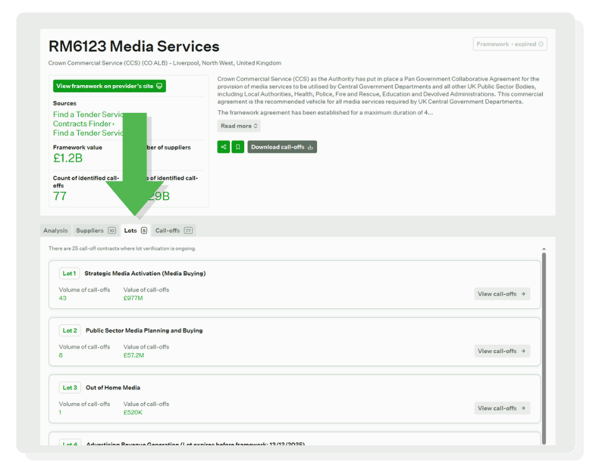
Using a tool like Tussell, you can:
-
Spot high-priority Lots. Just because a Lot exists doesn't mean it's really getting used. Lot Intelligence means you can break down the volume, value and type of call-off contracts awarded through a Lot - helping your team narrow down which Lots are be worth applying if the framework is re-tendered.
-
Identify new framework channel partners. If a supplier is regularly winning work through a Lot you're locked out of, use this as a trigger to approach them as a potential delivery partner. That way, you stand to benefit from Lots that you were otherwise excluded from.
-
Find 'Lot spillage'. A Lot's description doesn't always match with what's actually awarded through it. Lot Intelligence means you can examine the contents of what's really going through a Lot - helping you team decide which routes to prioritise going forward.
... and much more. To learn more about Tussell's framework Lot intelligence & to book in a demo, head here.
How can I use Lots to unlock new markets & accounts?
Analysing framework Lot usage is valuable when deciding which agreements to apply for in the future.
But there's another way to use this data that could benefit you today: using Lot data to identify new framework partners.
You can find potential partners who are either on or are regularly winning work through a Lot - and then pitch yourself as a delivery partner.
That way, you stand to benefit from the Lot's opportunities without directly being on the agreement.
You can also:
-
Gain visibility of tenders through your partners (opportunities that would otherwise go unpublished publically)
-
Begin devising how you might approach future iterations of the framework together (e.g. one partner taking one Lot, the other taking another)
-
Gain a better understanding of how a Lot really gets used by buyers
By treating Lots as potential partnering channels, they represent a way to unlock new accounts or markets that you'd otherwise be locked out of.
Conclusion: why Framework Lots matter, a lot
Frameworks are being used more and more to award public sector contracts.
They open the gate to many public sector markets - but their Lots determine which opportunities you're able to access.
Applying for frameworks and their Lots is not a free exercise. It takes time, money and resources to go through the application process. This can be especially burdensome for SMEs and new entrants.
This effort is magnified if your team takes a 'scattergun' approach to Lot application, applying to as many as possible in the hopes that some will bear fruit.
Taking the time to narrow down which Lots are truly worth your time applying not only saves you money in the short term, but it puts you in the best position to compete for relevant, regular opportunities in your market.
Even if you don't get onto a Lot, you shouldn't treat them as a dead-end. Usage data can help you identify potential Lot partners, promising to open up agreements that you would otherwise be locked out of.
Tussell's framework Lot intelligence enables your time to identify the Lots your target accounts and partners actually use. To see how it works in action, book in a call with our team.
***
FAQs
Is it better to apply for more framework Lots or fewer?
More is not always better. Applying for too many Lots can stretch bid resource, dilute the quality of your submissions and leave you with positions on Lots that do not generate meaningful opportunities.
A better approach is to prioritise Lots where three things overlap: your business can credibly deliver, your target buyers are actively using the Lot, and the competitive landscape gives you a realistic chance of winning.
How many framework Lots should a supplier apply for?
There is no universal number. The right number depends on your service range, delivery capacity, geography, buyer targets and bid resource.
Large suppliers may be able to justify applying across multiple Lots. Smaller or more specialist suppliers may be better served by focusing on fewer, higher-fit Lots where buyer demand is proven.
How do I know if a framework Lot is worth the bid effort?
A framework Lot is worth considering if it meets four tests:
-
It matches your products, services or delivery model
-
It is used by buyers you care about
-
It has generated enough call-off value or volume to justify the effort
-
You have a credible route to compete against incumbent suppliers
If a Lot looks relevant on paper but has little or no call-off activity, it may not be worth prioritising.
What data should suppliers review before applying for a framework Lot?
Suppliers should review the Lot’s call-off history, including total awarded value, number of awards, active buyers, incumbent suppliers, average contract size and recent usage trends.
They should also check whether their target accounts have used the Lot before. A Lot with high total value may still be a poor fit if the activity comes from buyers outside your target market.
How should suppliers compare two similar framework Lots?
Suppliers should compare similar Lots by looking beyond the scope wording. The stronger Lot is usually the one with clearer evidence of buyer demand.
Useful comparison points include call-off value, call-off volume, buyer mix, supplier mix, contract size, renewal patterns and relevance to target accounts.
How can large government suppliers improve their framework Lot strategy?
Large suppliers should map their framework Lot positions against real buyer usage. This means checking whether they are appointed to the Lots their target accounts actually use, where competitors are winning, and where upcoming expiries may create new opportunities.
For larger firms, the issue is often not whether they are on frameworks at all. It is whether their framework coverage matches where demand is actually flowing.
How does Tussell’s framework Lot intelligence support Lot selection?
Tussell’s framework Lot intelligence helps suppliers see which call-off contracts were awarded through specific framework Lots.
This allows suppliers to assess Lot usage by value, volume, buyer and supplier, helping them prioritise the Lots most likely to support their public sector growth strategy.