













.png)
![New Nav Bar - New Tag [Suppliers] PNG](https://www.tussell.com/hubfs/New%20Nav%20Bar%20-%20New%20Tag%20%5BSuppliers%5D%20PNG.png)

%20v1.png)








.png?width=80&height=80&name=james%20v2%20(1).png)



The UK public sector framework landscape is fragmented across dozens of providers, each publishing on their own portals and timelines. Finding relevant agreements online is just the first step.
Evaluating which are commercially active in your sector, used by your target buyers, and worth the application effort requires data that the public portals do not easily provide.
This guide explains how to find public sector procurement frameworks and how to evaluate which ones are worth pursuing, using call-off activity, competitor usage, and buyer demand as your criteria.
Skip ahead to read about:
- What is a procurement framework?
- How do I find public sector procurement frameworks?
- How to evaluate which frameworks are worth applying for
- How to find procurement frameworks using Tussell
What is a procurement framework?
A procurement framework is a pre-agreed arrangement between one or more public sector buyers and a group of approved suppliers.
Once a supplier is accepted onto a framework, public bodies can buy from them without running a full open procurement process each time. Instead, they issue call-off contracts to suppliers already listed on the framework, either directly or through a mini-competition.
Many frameworks are split into Lots, which group suppliers by service, product type, geography or another category. Suppliers may be appointed to one or several Lots, and buyers usually call off from the Lot that best matches their requirement.
Most frameworks are closed once the initial supplier list is awarded, so no new suppliers can join mid-term. Dynamic Markets and Open Frameworks are exceptions: Dynamic Markets allow applications throughout their lifetime, and Open Frameworks let suppliers join at set intervals.
Frameworks are managed by a range of private sector firms and contracting authorities, the most significant being the Government Commercial Agency (GCA, formerly Crown Commercial Service or CCS), which manages frameworks used across central government, the NHS, and local authorities.
In 2025, more than £60 billion of UK public sector contracts were awarded through framework agreements. Being on the right frameworks (and Lots) is not just useful. In many categories, frameworks are the primary procurement route and the only way to bid on the majority of public sector contracts.
How do I find UK public sector frameworks?
Framework publication in the UK is fragmented. There is no single place where all active frameworks are listed, and the portals you need to monitor depend on which buyers and sectors you are targeting.
-
Find a Tender and Contracts Finder cover frameworks where publication is legally required: Find a Tender for above-threshold procurements, Contracts Finder for lower-value contracts across central government. These are the starting point, but they do not cover everything.
-
Buying consortia manage their own frameworks through their own portals. YPO, ESPO, NEPO, NEUPC, and Scotland Excel each manage agreements used by local authorities, schools, and other public bodies, often without those appearing prominently on Find a Tender. The Government Commercial Agency also manages a significant number of public sector frameworks which are listed on their website.
-
Sector-specific framework managers add further complexity. SCAPE, Fusion21, LHC, and the South East Consortium each manage frameworks for the construction, housing, and social housing sectors. Homes England, NHS Shared Business Services, National Highways, Network Rail, Transport for London, HS2, Ministry of Defence, and L&Q all manage frameworks of their own. None of these sit in one place.
-
Devolved administrations operate separate systems for contract and framework publication. Scotland uses Public Contracts Scotland, Wales uses Sell2Wales, and Northern Ireland uses eSourcing NI. Scotland Excel manages many local government frameworks in Scotland.
The practical result is that a supplier checking only Find a Tender and Contracts Finder will miss a significant portion of the framework landscape, particularly in construction, housing, infrastructure, local government and the NHS.
Monitoring when frameworks are due to expire and when replacements will be advertised is just as important as knowing which ones are currently open, since most frameworks close applications quickly and remain shut for years.
Need help kickstarting your framework search? Consult Tussell's 2026 Framework Directory.
How to evaluate which procurement frameworks are worth applying for
Finding a framework is straightforward. Deciding whether it is worth the effort of applying is harder.
These are the five questions to ask before committing to a framework application:
-
Are your target buyers using it? A framework may be well-known but rarely used by the specific departments or authorities you sell to. Check which buyers have called off from the framework in the last 24 months. If your target accounts are not represented, the commercial opportunity is weaker than it looks.
-
What call-off volume has it actually generated? Headline framework values are set at the outset and are rarely meaningful. The number that matters is total call-off contract value: what buyers have actually spent through the framework. A £500m framework that has generated £12m in call-offs over two years is very different from one that has generated £400m. Volume of contracts issued matters too, not just total value.
-
Are your competitors on it, and are they winning? If a direct competitor is listed on a framework and winning call-off contracts through it, you need to be on it too. If a competitor is listed but not winning, the framework may be less commercially active than it appears.
Knowing the difference saves you from chasing frameworks that look busy on paper but produce little real pipeline. -
Do the contract sizes fit your business? Some frameworks produce a small number of very large contracts. Others generate many smaller ones.
Check the distribution of call-off values, not just the average. A framework that produces mostly £50m+ contracts is less useful to a company bidding at £500k. -
Which framework Lot is most relevant - and is it actually being used? Many large frameworks contain several Lots, not all of which will be relevant to you. And even if the framework overall sees strong usage, the specific Lot you’re bidding for may not. So, get granular with your analysis. Even the public sector’s busiest frameworks can contain Lots that see almost no call-off activity.
-
When does it expire, and what replaces it? Most frameworks are closed once awarded. If a framework you want to join expires in four months, you may not have enough time to benefit from it before the next procurement cycle begins.
But an expiring framework signals that a replacement is likely coming. Getting early sight of expiring frameworks lets you prepare for the successor before the notice goes live.
Conversely, if a framework has just started, consider how you could gain access to the framework without joining it directly - for example, by partnering with a firm that successfully secured a place.
How to find procurement frameworks using Tussell
Tussell brings together UK public sector frameworks all in one place, covering agreements managed by the Government Commercial Agency, YPO, ESPO, NEPO, NEUPC, Scotland Excel, NHS Shared Business Services, SCAPE, Fusion21, LHC, Homes England, National Highways, Network Rail, Transport for London, Ministry of Defence, and others.
Rather than trying to monitor each framework manager's portal separately, you can search and filter across the full landscape from a single view.
You can use Tussell to:
-
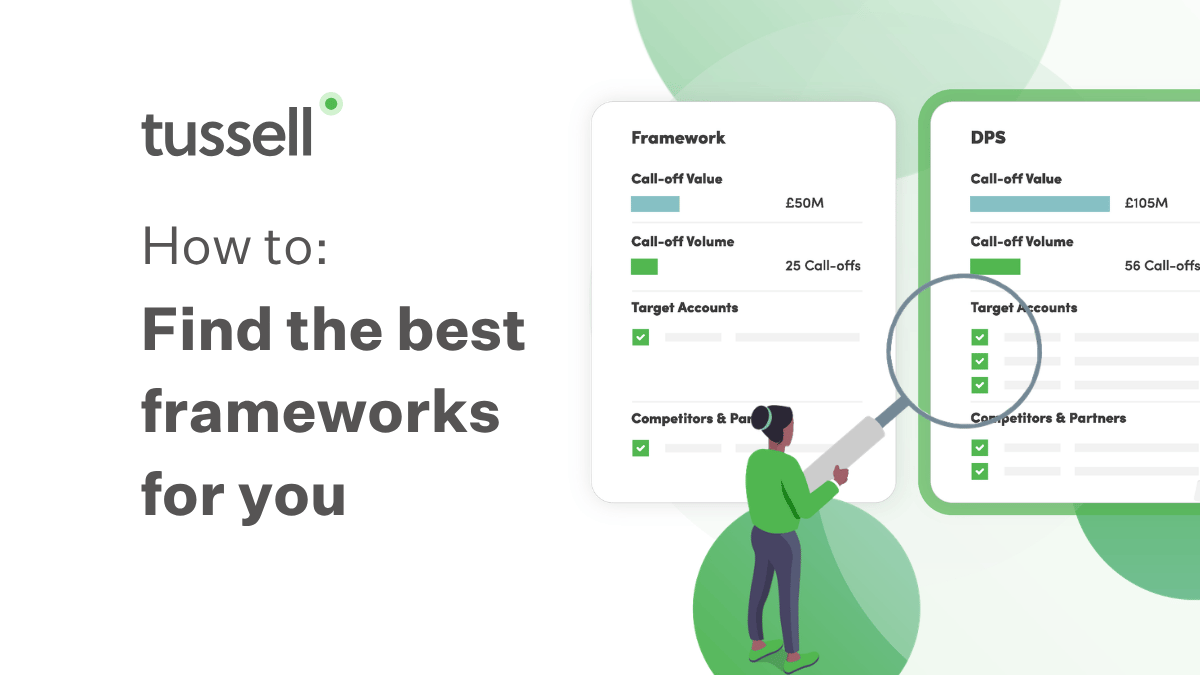
Identify the most valuable frameworks in your sector. See which frameworks - and Lots - generate the most call-off activity in your category by comparing total awarded contract values.
Headline framework values set at the outset often overstate real activity. Tussell shows what has actually been spent, and through which frameworks, so you can prioritise agreements that produce real pipeline rather than large numbers on paper.
Filtering for call-off contracts with cloud-related keywords, for example, surfaces 101 different frameworks used to award cloud contracts over the past 24 months. -
See which frameworks - and Lots - your target accounts and competitors are on. Find out which agreements your target buyers (central and local government departments, NHS trusts, rail bodies, and more) are actively calling off from, and which frameworks your competitors are winning business through.
This tells you where procurement activity is actually concentrated. Over the past 24 months, Capita won its highest value call-off contract via Network Connectivity & Telecommunications Solutions, but won more contracts by volume via Managed Services. That split is invisible from framework listings alone. -
Get visibility on what is being procured through frameworks. There is no requirement for buyers to publish individual tenders under a framework agreement, which means a significant portion of framework activity never appears on Find a Tender.
Tussell uses contract award data to show what has been awarded through each framework (and Lot) and to which suppliers, so you can see the full picture rather than just what was openly advertised. Filtering for frameworks used to award recruitment services contracts worth over £10 million in the past 24 months, for example, narrows the full landscape to 23 high-value frameworks worth targeting. -
Focus framework applications where they will actually produce pipeline. Framework applications take time and resources. By seeing which frameworks - and Lots - your competitors, partners, and customers are genuinely using, you can direct that effort where it counts rather than applying broadly and hoping.
Filtering by buyer, for instance, shows immediately that HMRC drew on 5 different agreements to award Hard FM contracts in the past 24 months. With Tussell, you can set alerts for when these agreements are due to expire and when new iterations will be opening for bids. -
Stream framework data into your business. For teams that want to build framework intelligence into their own workflows, Tussell's API gives direct access to framework data so you can flag, qualify, and track opportunities in your existing systems.
To learn more about Tussell's framework intelligence, head here.

Frequently Asked Questions:
How do I choose which government procurement frameworks to apply for?
Start with the buyers you are targeting and check which frameworks they have actively called off from in the last 24 months, what they have spent, and whether your competitors are listed. A framework is only worth applying for if your target buyers are actively using it. Tussell brings every UK public sector framework together in one place: search and filter across all framework operators without checking each portal individually, set up notifications for frameworks you are tracking, and check call-off activity by buyer and sector before committing to an application.
Which government frameworks are worth bidding for?
The frameworks worth pursuing are those with a track record of generating call-off contracts in your sector, used by the specific buyers you sell to, and at contract values that fit your business. Headline framework values are poor indicators of commercial activity. Total call-off value and the volume of contracts issued are what matter. Tussell's Frameworks reporting shows both figures across active and historic UK public sector frameworks, so you can compare real commercial activity rather than paper values before you decide where to focus your effort.
How can I find which procurement frameworks my competitors are using?
Check which call-off contracts your competitors have won and identify the framework agreements used to award them. If a competitor is repeatedly winning public sector contracts through a specific framework, that framework may be worth targeting. If they are listed but rarely winning through it, the opportunity may be weaker than it looks. Tussell lets you search competitor and partner activity across public sector frameworks so you can see which agreements are commercially active in your market, which buyers are awarding work through them, and where similar opportunities are likely to appear.
Which procurement frameworks should a technology company apply for?
The highest call-off volume technology frameworks in UK public sector are G-Cloud, Technology Services (TS3/TS4), Cyber Security Services, Digital Data and Technology Specialists (DDTS), and SPARK - although these are not the only frameworks worth considering. The right choice depends on what you sell and which public bodies you target. G-Cloud is the most widely used for cloud and SaaS. Technology Services covers bespoke development and systems integration. A technology supplier should map their offering to framework lots and search for frameworks actually being used to award relevant contracts before applying, rather than applying broadly across all frameworks.
How do I find out when a procurement framework I want to join opens?
Most frameworks are advertised on Find a Tender before applications open, but with over a dozen framework managers each publishing on their own timelines, staying on top of expiry dates manually is difficult. Tussell tracks expiry dates across every UK public sector framework and lets you set up notifications for the ones you are watching, so you get early warning when a replacement is likely to be advertised rather than finding out after the window has closed.
Conclusion
The frameworks that deliver pipeline are the ones being used by your target buyers, generating contracts at values that suit your business, where your competitors are winning business. That judgement requires data, not guesswork. Tussell's framework intelligence gives you the call-off activity, competitor usage, and buyer data to make it.
.png?width=815&height=200&name=CTA%20(3).png)
Related: How to find government tenders and contracts
Related: What is pre-tender intelligence?