












.png)
![New Nav Bar - New Tag [Suppliers] PNG](https://www.tussell.com/hubfs/New%20Nav%20Bar%20-%20New%20Tag%20%5BSuppliers%5D%20PNG.png)

%20v1.png)









.png?width=1280&height=800&name=Use%20data%20to%20find%20the%20right%20partners%20(11).png)




The 2026 local elections were more than a routine mid-cycle test: they came amid a fragmented political landscape, and included councils whose 2025 contests were delayed by Local Government reorganisation.
So, in an era of local government financial distress and DOGE-style pledges to cut council spending, what could shifting political control and the rise of Reform UK in the 2026 local elections mean for English council procurement?
In this blog, we investigate the relationship between local election results and council procurement spending with private suppliers. We also cover how procurement is affected before and during local elections, and whether Reform UK's 'DOLGE' is already reducing procurement spending.
Skip ahead to read about:
-
When were the local government elections, and why did they matter?
- Do local election results change procurement spending?
- Can Reform UK reduce local government spending?
- Where can local authorities make a difference in procurement spending?
- Conclusion
🗳️ When were the 2026 local government elections?
The 2026 local government elections took place on Thursday, May 7th, and saw Reform UK pick up 1,451 council seats.
Overall, the elections covered 4,851 seats across 134 of England's 317 councils, alongside shadow elections for two new Surrey unitary authorities. Six mayoral elections also took place, alongside elections for the Scottish Parliament and Welsh Senedd.
Local elections are often seen as a referendum on national politics. But councils are also major public buyers in their own right, with responsibility for massive procurement categories including transport, social care, waste, road maintenance and local development.
Local Government is a major force in the procurement market, accounting for more than a third of public sector procurement spending.
So what happens in the weeks and months before polling day - and will the 2026 election results change how councils spend?
💷 Is procurement restricted before local elections?
In some senses, yes - but the restriction is narrower than is sometimes assumed.
The official 'pre-election period' begins once the notice of election is published. For the 2026 local elections, relevant councils published their notices by March 30th.
During the pre-election period, local authorities enter a window of heightened sensitivity. The Local Government Association states that, in the vast majority of cases, the pre-election period should have no impact on normal council business, including the approval of planning decisions. But councils are advised to avoid publishing material on controversial issues or activities that could be seen to influence voters.
For procurement, that does not mean business stops. Councils still need to commission services, maintain contracts and fulfil statutory duties.
Therefore, the effect is more likely to be seen in the handling of politically sensitive procurements: major awards, market engagement exercises or public announcements may be delayed, softened or handled with additional caution.
As a general rule, the communications around procurement are more constrained than the underlying procurement process. A tender may still be prepared internally, but publicity around a major new initiative may be held back until after polling day.
📊 Do local election results change procurement spending?
In theory, the outcome of local elections can affect procurement spending.
In practice, the effect is often small, uneven and delayed.
Most local authorities are under severe financial pressure, while also facing legal obligations to maintain expensive services including social care, waste management, highways and children’s services. These categories account for a large share of council procurement spending, and they are difficult for a new administration to change quickly.
The areas most exposed to political change tend to be more discretionary: consultancy, climate initiatives, transformation programmes, equality initiatives and some regeneration projects. But these categories usually represent a small minority of total procurement spend.
And, even where a new administration wants to cut, cancel or redirect spending, existing contracts cannot usually be dissolved mid-term without legal, financial or operational consequences. In many cases, councils have to wait until contracts expire before making substantial changes.
This matters because some of the most politically visible categories are not necessarily the largest. In Tussell's new Public Sector Consultancy Market Report, we found that despite significant public attention, public sector management consulting accounts for only 2% of total public procurement spending.
In practice, this means changes in absolute procurement spending are often better explained by local service pressures, capital investment cycles, inherited contracts and historic spending patterns than by which party takes control in a given election.
The chart below uses Tussell data to show absolute procurement spending before and after the May 2025 elections for eight unitary authorities that changed leadership that year.
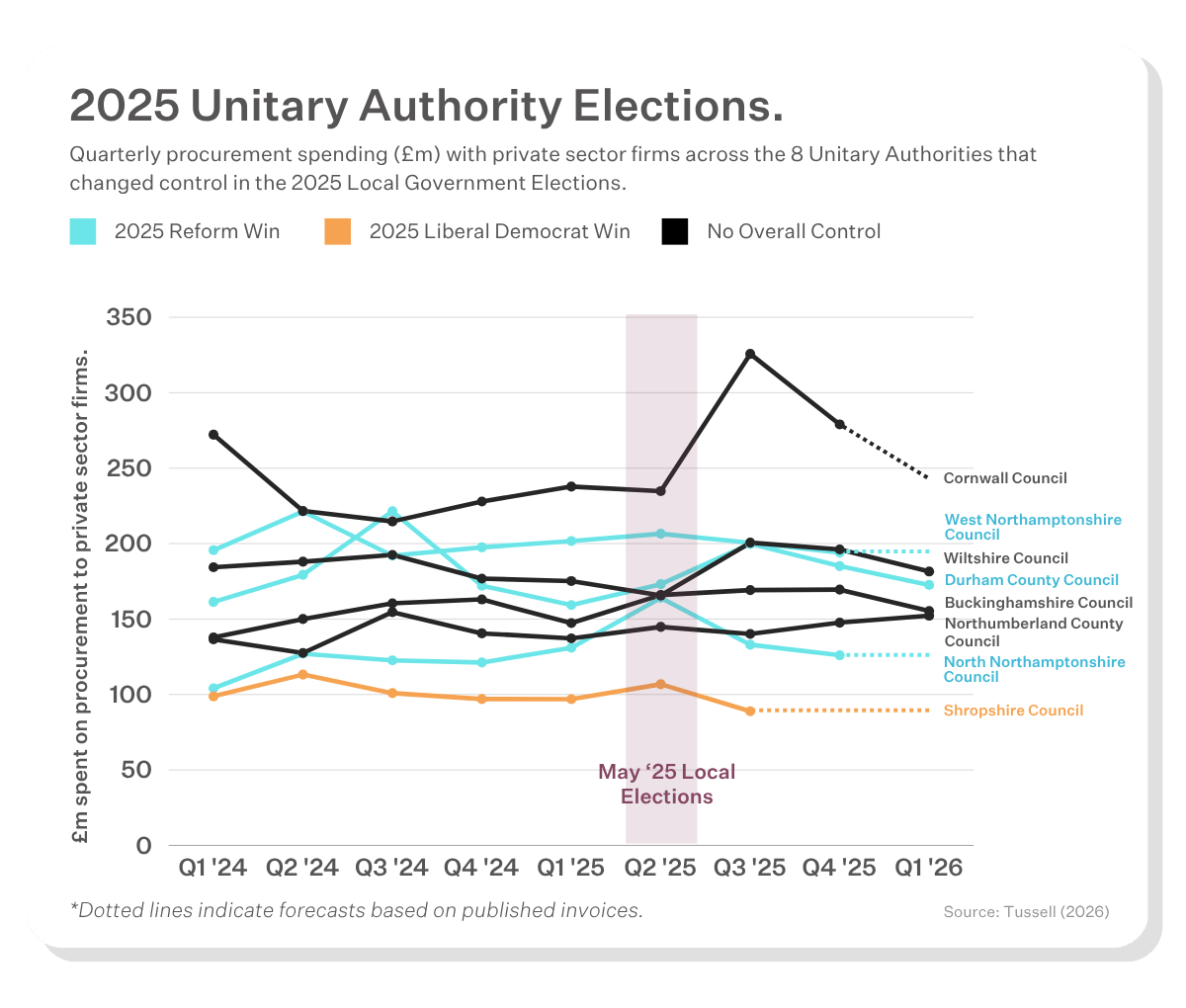
In 2025, three councils moved to Reform, one to the Liberal Democrats, and four ended up under no overall control. And, of this sample, no clear pattern emerged in total procurement spending in the quarters after the election based on which party took control.
*Cornwall Council’s uptick in spending in Q3 2025 can largely be attributed to payments to Biffa for household waste collection. While it is unclear why payments peaked at this point, waste collection is a statutory service with limited scope for short-term political discretion, making it highly unlikely that the increase was triggered by the council’s new leadership.
Can Reform UK reduce local authority spending?
After significant wins in the 2026 local government elections, the question of whether Reform UK will reduce local authority spending is front of mind for public sector suppliers and procurement teams across the country - and there's a strong historical basis for those concerns...
When Reform UK won control of a handful of councils in the 2025 local elections, the party promised to tackle "wasteful spending" and "complacency" within Local Government.
And, in June 2025, Reform announced the creation of an internal 'Department for Local Government Efficiency' (or DOLGE, modelled on Elon Musk's Department of Government Efficiency) tasked with "auditing local government spending to increase transparency and ensure taxpayer money is spent solely on activities that benefit residents".
However, a Financial Times investigation revealed that the DOLGE/DOGE unit carried out no financial audits within the first 6 months after the election wins, and Kent CC's DOLGE Head resigned, claiming the council had "not actually made any cuts", raising questions about the effectiveness of the project.
On the other hand, "Reform UK claims to have saved Councils over £100m" by cutting green initiatives and cutting planned spending.
So, what does the data show?
Analysis of invoices from private sector suppliers valued at over £500, using data from Tussell’s public sector market intelligence platform, shows that the six largest county councils that flipped to Reform control in Q2 2025 did not show a clear or sustained reduction in supplier invoice spend in the first three quarters after the elections.
.png?width=1200&height=1020&name=GEs%20%26%20Procurement%20-%202015%20(2).png)
Notably, Kent County Council, which recently announced projected savings of £100m whilst increasing council taxes by nearly 4%, saw its procurement spending significantly increase in the three quarters after Reform assumed office.
However, it should be noted that the extent to which this increase was expected or 'baked in' before the election is not measured in this analysis. .png?width=1200&height=1020&name=GEs%20%26%20Procurement%20-%202015%20(3).png)
By comparison, the two county councils won by the Liberal Democrats in 2025 recorded spending within a similar range, despite the party not campaigning on the same cost-cutting agenda.
The Labour Party, the Green Party, and the Conservatives did not take control of any County Councils in 2025.
🌱 Where can councils make a difference when it comes to procurement spending?
Whilst local authorities have limited power to curtail procurement spending due to long contract terms and statutory obligations, councillors do have significant power to change social value criteria in public procurement.
Where applied, social value criteria can carry meaningful weight in bid evaluations, often at around 10% or more. And, social value offers the potential to bring jobs, business, education, and other social and economic perks to local communities.
Councillors can also work with procurement teams to strengthen the role of small businesses, voluntary organisations and locally based suppliers in council supply chains - provided this is done transparently, proportionately and within procurement rules.
Local Government has historically led the way on SME procurement. More than 30% of local authority procurement spending goes to small and medium-sized firms, compared with 11% for Central Government.
New powers allowing some contracts to be reserved for local suppliers could give newly elected councils another route to keep more public spending within the local economy. But this is likely to affect the distribution of procurement spend more than the overall level of spending.
🌅 Conclusion
Local elections can change the politics of procurement, but they do not automatically produce immediate changes in spending.
Councils remain constrained by statutory duties, long-term contracts and rising demand for services such as social care, waste and children’s services. As a result, the impact of political change is more likely to appear in what councils buy, which suppliers they work with, and how they prioritise social value, local growth and SME participation.
The early evidence from 2025 supports this: councils that changed political control did not see a clear increase or decrease in procurement spending in the quarters after the election.
As the dust settles after the 2026 local elections, suppliers should be watching not just whether councils spend less, but how changing political priorities reshape local procurement markets.
Tussell helps suppliers track public spending, contract awards, framework usage, and buyer behaviour across the UK public sector. Book a chat with the Tussell team to understand how changing buyer behaviours could affect your pipeline.