












.png)
![New Nav Bar - New Tag [Suppliers] PNG](https://www.tussell.com/hubfs/New%20Nav%20Bar%20-%20New%20Tag%20%5BSuppliers%5D%20PNG.png)

%20v1.png)











The introduction of The Social Value Act in 2013 made it mandatory for public sector buyers to consider social, economic and environmental benefits when procuring goods and services.
Since then, The Procurement Act 2023 and PPN 026 have built on the way the public sector thinks about social value.
The new Labour government also plans to further expand social value in procurement by establishing a Social Value Council.
*
This article explains what is meant by social value and how procurement teams across the country must consider social value in the procurement process.
The article may be used by procurement professionals to sharpen up on their social value obligations, or by suppliers to government to understand how social value will be considered in relation to their bids.
Skip ahead to read about:
- Social value: what is it?
- How social value is considered in procurement
- Social value in the devolved regions
- The Procurement Act 2023
- How suppliers should think about social value
- How buyers should think about social value
- Summary and conclusion
***
This article is part of a series of articles on the 2023 Procurement Act.
Head to Tussell's Procurement Act Hub for all the information and resources you need to get Procurement Act-ready.
Social value: what is it?
The Covernment Commercial Agency defines social value in procurement as “ensuring that public spending generates additional economic, social and environmental benefits beyond just the goods or services being procured.”
In other words, it’s about procurement that positively impacts people and communities outside of the scope of the contract itself.
Social value is split into three broad pillars:
-
Social - increasing the wellbeing of individuals and communities.
-
Economic - increasing societal wellbeing through economic policy and business practices
-
Environmental - promoting sustainable practices and processes that protect the natural environment and ensure a viable future for everyone
Suppliers with a high social value offering will prove that they can qualitatively improve local well-being across one or multiple of these verticals.
How is social value considered in procurement?
The Social Value Act requires public bodies to consider how the services they are procuring can improve social, economic, and environmental well-being in the communities they serve.
Whilst some social value criteria may benefit people all over the world (eg. carbon reduction, ethical supply chains), social value mostly refers to localised benefits that can be directly felt within the constituency that is being served.
What is the Central Government Social Value Model? (PPN 026)
In August 2026, PPN 026 introduced a new Central Government Social Value Model that changed the way in which Central departments, their executive agencies, and non-departmental public bodies consider social value in procurements valued at £1m or more.
The new Model significantly narrows the scope of Central Government social value to focus primarily on jobs and skills (rather than other social or environmental factors).
The procurement policy note also mandates a minimum of 20% social value weighting for Central Government contracts worth over £5m. For contracts valued between £1-5m, the historical 10% minimum weighting still applies.
.png?width=450&height=236&name=Template%20(11).png)
Learn what PPN 026 means for your team
What is the TOMs Local Government Social Value Model?
The Local Government Association (LGA) - together with Tussell customer Social Value Portal - has put together the TOMs framework for Local Council's to quantify and review social value considerations.
The TOMs cover 5 distinct themes:
-
Promoting skills and employment
-
Supporting the growth of responsible businesses
-
Creating healthier, safer and more resilient communities
-
Protecting and improving the environment
-
Promoting social innovation
Councils are also encouraged to publish a social value strategy online that outlines their specific social value goals.
Through doing this, they can increase transparency and arm suppliers with the information they need to provide meaningful social value pledges that serve specific wellbeing objectives in local areas and communities.
Here's an example from the London Borough of Waltham Forest. Every year, they publish a new social value statement to reaffirm their goals to suppliers and to measure social value progress.
.png?width=525&height=446&name=Walthamstow%20(1).png)
How does social value work in the devolved regions?
Northern Ireland, Scotland and Wales all have different approaches to social value that have been enacted via different regional social value legislation.
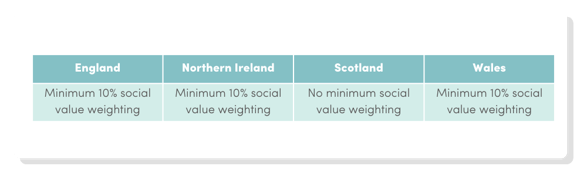
In each UK region - excluding Scotland - social value must comprise at least 10% of each procurement's total award criteria. Although this weighting may be increased at a contracting authority's own discretion.
Bid-writing experts and Tussell customers - Executive Compass - "regularly complete submissions where social value comprises up to 25% of the overall marking criteria, including submissions for Scottish [Government]."
How does social value work in Northern Ireland?
PPN 01/21, which mandates the minimum 10% social value weighting in Northern Ireland for high-value contracts, outlines 4 key themes for scoring social value.
These four themes (and some of their corresponding indicators) are listed below:
-
Increasing secure employment and skills
- Procurement contracts that:
-
Create employment, re-training and other return to work opportunities for those furthest from the labour market
-
Support educational attainment in the workforce, including training schemes that address skills gaps and result in recognised qualifications.
-
Increase the representation of disabled people in the contract workforce.
-
Create opportunities for entrepreneurship and help new, small organisations to grow, supporting economic growth and business creation.
-
- Procurement contracts that:
-
Building ethical and resilient supply chains
- Sourcing strategies that:
-
Create a diverse supply chain to deliver the contract including new businesses and entrepreneurs, startups, SMEs and VCSEs.
-
Promote ethical supply chains and practices.
-
- Sourcing strategies that:
-
Delivering zero carbon
- Procurement strategies and specifications that:
-
Deliver additional environmental benefits in the performance of the contract including working towards net zero greenhouse gas emissions.
-
- Procurement strategies and specifications that:
-
Promoting wellbeing
- Contracts that include measures to:
-
Support the health and wellbeing, including physical and mental health, in the contract workforce.
-
Allocate a percentage of the budget to artwork or cultural activities.
-
- Contracts that include measures to:
The NI Department for Finance urges buyers to weigh up cost, quality, and social value when awarding suppliers and making procurement decisions.
How does social value work in Scotland?
Whilst Scotland requires no minimum weighting to social value, the Scottish Government urges procurement teams to consider 'social impact' in addition to cost when making procurement decisions.
SPPN 10/2020 defines positive social impact as outcomes that align with Scotland's National Performance Framework and the UN's 17 Sustainable Development Goals.
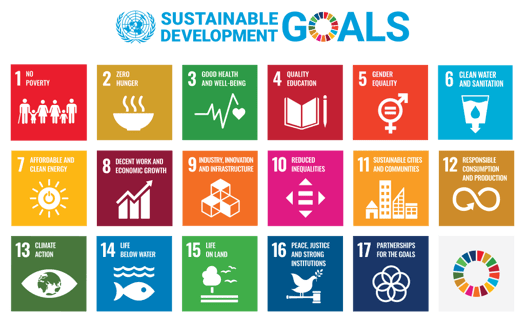
The National Performance Framework (NPF) sets out national indicators for Scottish wellbeing that cover children and young people, communities, culture, economy, education, environment, fair work and business, health, human rights, internationalism, and poverty.
The specific criteria used to measure the NPF can be found on the Scottish Government website.
How does social value work in Wales?
Since November 2020, Welsh contracting authorities have been required to support 8 Welsh wellbeing goals in addition to providing a minimum of 10% weighting to social value in procurement.
The 8 goals - as defined by the Well-being of Future Generations Act - are as follows:
-
A prosperous Wales
-
A resilient Wales
-
A healthier Wales
-
A more equal Wales
-
A Wales of more cohesive communities
-
A Wales of vibrant culture and thriving Welsh language
-
A globally responsible Wales
%20Social%20Value.png?width=525&height=446&name=Welsh%20(Wales)%20Social%20Value.png)
These 8 goals are to be supported via the following overarching 'Social Value /Community Benefits policy objectives.'
-
Training and recruitment of economically inactive people
-
Supply chain initiatives
-
Environmental initiatives
-
Cultural initiatives
-
Educational initiatives
-
Community initiatives
-
Retention and training of existing workforce
-
Working with the 3rd sector (VCSEs)
These 8 policy objectives can be tailored in the context of specific community needs and contractual requirements in order to support people and communities in Wales.
How did the Procurement Act 2023 change social value?
The Procurement Act, which went live on February 24th 2025, makes no specific reference to social value. However, it did usher in some small but powerful changes to the way the public sector thinks about social benefit in procurement.
Historically, the Public Contracts Regulations 2015 required procurement teams to reward the Most Economically Advantageous Tender (MEAT).
The Procurement Act amended this existing standard, requiring procurement teams to award a contract to whichever supplier submits “the most advantageous tender (MAT) that the contracting authority considers (a) satisfies their requirements and (b) best satisfies the award criteria by reference to the assessment methodology and the relative importance of the criteria.”
 Download Tussell's free Procurement Act guidebook
Tussell clients and procurement experts, Executive Compass, also note that Section 12 of the Act outlines the requirement for contracting authorities to have regard for 'maximising public benefit', while Chapter 5, Section 52 mandates the publishing of annual key performance indicator (KPI) statistics for all suppliers on contracts worth over £5m.
"As social value commitments often form a contractual KPI, supplier performance for social value will have greater monitoring and oversight." (Executive Compass).
PPN 026 now requires all new in-scope Central Government contracts to set and measure at least one social value KPI.
How suppliers should think about social value
Social value is a critical component for suppliers hoping to stand out in a crowded public sector marketplace - especially when it comes to medium and high-value contracts.
Most social value legislation includes caveats so that the rules and advice can be applied proportionately by procurement teams so as not to disadvantage smaller suppliers.
With that being said, even with small contracts it never hurts to consider and outline the way in which you intend to support environmental, social and economic wellbeing to local communities outside the core scope of the contract.
Considering the specific social value strategies of a buyer is also helpful when putting together a bid - this includes regional and national targets as well as specific strategies published by local governments.
Beyond these specific strategies and goals, several core social value themes are consistent across the whole country. These ought to be considered when putting together any high-value bids.
-
Skills, training and employability
-
Environmental sustainability & carbon reduction
-
Supporting VCSEs and SMEs
-
Thriving local economies
Of these four core themes, working with local businesses, VCSEs and SMEs is perhaps the easiest way of providing a localised social and economic benefit.
Tools such as Tussell can help you identify locally-based VCSEs and SMEs in your sector with a proven track record of working with government.
.png?width=815&height=200&name=TUSSELL_Demo_CTA_Banners%20(12).png)
How buyers should think about social value
The way you think about social value will vary depending on the specific social value legislation governing your locality, organisation type or region.
However, building a specific social value strategy can be a powerful tool to ensure social value is delivering material benefits to your local community.
According to the LGA, only 23% of local councils have published a social value strategy online. And, a staggering 44% of councils have made no mention of social value on their website.
Having a clear and easily accessible social value strategy will enable prospective suppliers to tailor their bids around your wellbeing goals and encourage them to deliver targeted social value in your constituency.
Making use of Carbon Reduction Schedules is another brilliant way of delivering environmental social value.
In terms of social and economic social value, procuring directly from local businesses, SMEs and VCSEs (when possible) is one of the most effective ways of supporting the local economy, generating social value and bolstering the voluntary sector.
Book a demo with the Tussell team to learn how Tussell can help you quickly identify local SMEs and VCSEs in your category with a proven track record of working with the public sector.
-1.png?width=815&height=200&name=TUSSELL_Demo_CTA_Banners%20(4)-1.png)
Summary and conclusion
Across the UK, social value already plays an intrinsic role in the procurement process. The recently published PPN 026 Central Government Social Value model only cements this further.
For this reason, understanding the broad strokes of social value legislation and the specific details of local social value plans is a must for anyone hoping to make smarter procurement decisions and/or do more business with the public sector.
Tussell is the market's trusted source of public sector market insights, and is already being used by buyers all over the country to promote social value through procurement and save time and money in the procurement process.
Tussell is also used by over half of the UK's Strategic Suppliers to diversify their supply chains and to find more opportunities to do business with the public sector.
Book a demo with the Tussell team today to find out how you can start benefiting today.

***
This article is part of a series of articles on the 2023 Procurement Act.
Head to Tussell's Procurement Act Hub for all the information and resources you need to get Procurement Act ready.
-1.png?width=450&height=330&name=Procurement%20Act%20Hub%20Graphics%20(1)-1.png)