












.png)
![New Nav Bar - New Tag [Suppliers] PNG](https://www.tussell.com/hubfs/New%20Nav%20Bar%20-%20New%20Tag%20%5BSuppliers%5D%20PNG.png)

%20v1.png)






.png?width=1280&height=800&name=How%20to%20(1).png)
.png?width=80&height=80&name=james%20v2%20(1).png)


If you sell to the public sector, the data to track your competitors already exists. Every above-threshold contract award is published on a government procurement portal, including the buyer, the supplier, the value, and the contract end date.
The challenge is keeping on top of it, and making sense of it. Contract awards are published by entity, not by parent company, which means most competitor activity can appear smaller than it actually is.
In this article, we explain how you can track your competitor's public sector activity & contracts, and how to use this intel to your advantage.
Skip ahead to read about:
- What contract data is publicly available
- Why tracking competitors is harder than it looks
- How to build a competitor monitoring process
- What to do with what you find
- Tools for tracking competitor government contracts
What contract data is publicly available?
The UK public sector publishes contract award notices across a range of platforms.
Find a Tender Service (FTS) - otherwise known as the Central Digital Platform - is the largest platform, and includes notices for the majority of in-scope above-threshold contracts. However, Contracts Finder and other portals hold notices from procurements not in scope of the Procurement Act and/or procured under the previous regime. Devolved nations publish through their own portals, including Public Contracts Scotland, Sell2Wales and eTendersNI.
Each award notice typically includes the contracting authority, contract title, award date, value, and the name of the winning supplier. For some contracts, notices are detailed. For others, information is sparse.
This data is free and publicly accessible. The challenge is how to interpret it at scale.
Why tracking competitors in public sector contracts is harder than it looks
Here is the problem most public sector sales teams run into: contract awards are published by the contracting entity, not by a supplier's parent company.
A company like Capita operates through dozens of legal entities. Contracts may be awarded to Capita Business Services Ltd, Capita Property and Infrastructure Ltd, Capita Symonds Ltd, Capita Managed IT Solutions Ltd, and many others. On Contracts Finder and FTS, each appears as a separate supplier name. A search for "Capita" will miss any contract where the subsidiary name does not contain that exact string.
The same applies to Serco, CGI, Atos, G4S, and most large public sector suppliers. A major competitor can have 30 to 60 or more subsidiary entities publishing contracts separately. Without entity consolidation and a detailed knowledge of previous acquisitions, a surface-level search gives you a fragment of the real picture - and a fragment that almost always makes your competitors look less active than they are.

How to build a public sector competitor monitoring process
Tracking competitor activity in public sector contracts requires systematically monitoring official procurement portals, award notices, and pre-tender pipelines.
By analysing what rivals win, which buyers they target, and when their current contracts expire, you can anticipate competitor moves and position your bids more strategically.
In practice, that means five things:
-
Start with a complete entity list. Before you can monitor a competitor, you need a list of every entity they operate through. For a large group, this means cross-referencing Companies House, procurement portals, and historical award notices to build a full entity map. Tussell's Competitor Tracker handles this automatically: select a competitor from a database of 390,000+ UK public sector suppliers, and Tussell consolidates all related entities into a single view.
-
Set up alerts on the consolidated group, not just the brand name. Manual name searches on Contracts Finder miss subsidiary awards. Alerts should fire on the full entity group to avoid the gaps described above.
-
Track by buyer, not just by value. A competitor winning a small contract with a new buyer can be an early signal of a relationship being built. Do not focus exclusively on large contracts - look at which buyers a competitor is active with, even at low values.
-
Review sector trends quarterly. Individual awards are useful. Patterns over time are more so. Is a competitor growing in one sector while pulling back from another? Are they doubling-down on one or multiple accounts? Award data aggregated over time makes these patterns visible - and aggregated invoice data can give you even better insights in public markets where contract publishing is patchy.
-
Track which frameworks your competitors are winning through. Contract award data tells you what a competitor has won, but not how the buyer procured it. If a competitor is consistently winning through a framework you are not listed on, that is a route-to-market gap - and one that is easy to miss if you are only monitoring open tender awards. Understanding which frameworks and Lots your competitors are using, and which buyers are calling off through them, tells you where you need to be to compete for that business.
What to do with what you find
Competitor intelligence is only useful if it changes what you do.
If a competitor is consistently winning with a buyer you have been targeting, that is worth knowing. It might change how you position your proposal, whether you look for a route in through a different procurement framework or Lot, or whether you deprioritise that buyer and focus somewhere the competitive position is better.
If a competitor is expanding into a sector where you are currently strong, that is an early warning. Monitoring the data before they become established gives you time to respond before the next tender goes live.
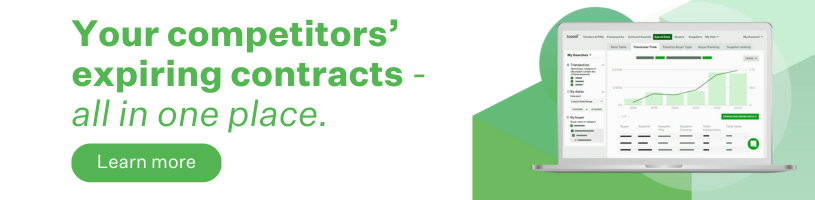
If a competitor is losing contracts, that is an opportunity. Most suppliers only find out a contract has ended when the replacement tender goes live - at which point the buyer has often already started conversations with preferred suppliers. Monitoring expiring contracts in advance gives you time to reach the buyer before the tender is published, which is when the relationship-building that shapes the outcome actually happens.
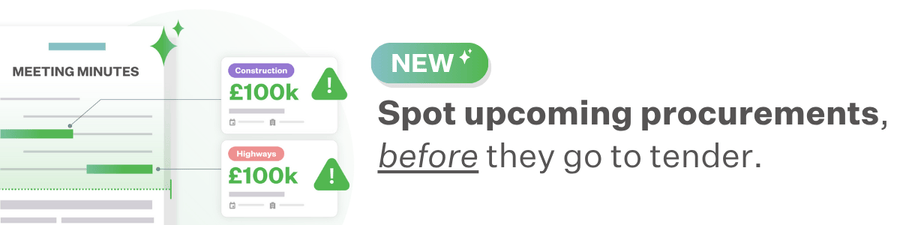
Even better: anticipate opportunities before they've ever entered the procurement stage. Buyers are constantly hinting at their future commercial activities in meeting minutes, pipeline documents and strategy reports. It's in this early pre-tender stage where you can carve out a real competitive advantage.
Once you've picked up on an upcoming procurement, reach out to the buyer, understand their needs, and stake your case before your competitors even know the opportunity exists.
Tussell clients get alerted whenever pre-tender buying signals emerge in their market using Tussell's Early Opportunities feed.
Put simply: the goal is to move from monitoring to action. Award data tells you what has happened. Your job is to use it to anticipate what comes next.
Tools for tracking competitor government contracts
Manual searches on procurement portals are free but incomplete and time-consuming. For any company with a serious public sector sales function, a dedicated intelligence platform is more practical.
The main criteria to look for:
Entity consolidation - can it track a competitor across all their subsidiary and acquired entities, not just one name?
Coverage - does it pull from FTS, Contracts Finder, devolved platforms, and other online portals?
Expiring contract alerts - can it flag when a competitor's contract is coming up for renewal?
Pre-tender buying signals - does it pick up hints of future procurements in meeting minutes, procurement pipelines and strategy reports?
Framework insights - does it track which framework was used to award each contract?
Invoice-level data - does the tool include invoice-level spend data to show key competitor trends and supplier relationships in public sector markets where contract notice publishing rates are low?
Tussell's Competitor Tracker is built for this use case. Select your competitors from a database of public sector suppliers, and Tussell automatically surfaces their government contracts: which buyers they are working with, the contract values, when those contracts expire, and which frameworks are being used. It is designed for companies that want to turn competitor intelligence into pipeline - not just a point-in-time snapshot.
Frequently asked questions
Can I track competitors on Find a Tender or Contracts Finder for free?
Yes, Find a Tender and Contracts Finder are free and publicly accessible. You can search by supplier name and set up basic email alerts. The limitation is that manual name searches miss awards made to subsidiary entities, so for any competitor that operates through multiple legal entities you will get an incomplete picture. For a one-off check, it is a reasonable starting point. For ongoing monitoring across more than one or two competitors, the gaps become significant.
Why can't I find my competitors' contracts?
If you've searched a range of online portals and still can't find all of your competitors' contracts, there's a good chance they were never published in the first place. The NHS - and some other large public sector buyers - publish only a small fraction of their contract awards online. Their contract wins may also be below-threshold, meaning there's no legal requirement for the buyer to publish them. In these instances, you can use a public sector market intelligence platform like Tussell to track invoice-level spending data and fill the gaps to uncover hidden supplier relationships.
How often is public sector contract award data updated?
Most contracting authorities are required to publish award notices within a set timeframe after signing, though compliance varies in practice. There can be a lag of weeks or months between a contract being awarded and the notice appearing on a portal. A platform that aggregates across sources will typically surface awards faster than checking individual portals manually.
How do I find all the entities a competitor operates through?
A combination of Companies House (for corporate group structure), historical contract award searches (to find variant entity names used in practice), and framework supplier lists (which often name entities explicitly) will get you most of the way there. For large groups with many subsidiaries, this is a significant research exercise. Tussell's Competitor Tracker handles entity consolidation automatically, grouping related entities so you can see a competitor's full public sector footprint in one view.
What is the difference between tracking competitors on Find a Tender & Contracts Finder versus using a dedicated platform?
Find a Tender and Contracts Finder gives you raw award data from one source with basic search and alerts. A dedicated platform consolidates multiple sources, resolves the entity problem, provides trend data over time, uncovers the frameworks driving contract wins, and surfaces expiring contracts before they go back out to tender. For occasional research, Contracts Finder may be adequate. For ongoing competitive monitoring across multiple competitors and sectors, a platform saves significant time and produces a more accurate picture.
How do I know when a competitor's public sector contract is about to expire?
Contract end dates are included in award notices when they are published. The challenge is aggregating and monitoring those dates at scale. Tussell's Competitor Tracker surfaces expiring contracts as a standard feature - you can see which of your competitors' contracts are due to end in the next three, six, or twelve months, so you know when buyers are likely to be back in the market.
Conclusion
Public sector contract data is one of the most underused sources of competitive intelligence available to suppliers. The data is there - the question is whether you have a process and the right tools to turn it into something your sales team can act on.
Tussell's market intelligence platform is trusted by leading suppliers to government to proactively monitor their competitors. To see it in action, book in a chat with our team.
Related: Tussell Competitor Tracker - see your competitors' full book of government business