











.png)
![New Nav Bar - New Tag [Suppliers] PNG](https://www.tussell.com/hubfs/New%20Nav%20Bar%20-%20New%20Tag%20%5BSuppliers%5D%20PNG.png)

%20v1.png)







.png?width=1280&height=800&name=Pubsec%20sales%20target%202027%20blog%20header%20(1).png)
.png?width=80&height=80&name=james%20v2%20(1).png)



Q4 is upon us, and that can only mean one thing: planning for 2027 has begun.
If your team is set to be hit with an ambitious public sector growth target for 2027, now is the time to start considering what tactics and strategies you will employ to get you there. Relying on this year's tricks might not cut it.
In this short guide, we outline the key things your team should be doing now to set yourselves up for success in 2027.
While we can't guarantee success with these tips, much of the this advice is drawn from the best practices and successes of Tussell's high-growth enterprise clients. Whether you're new to public sector sales, or an experienced veteran yourself, it's well worth considering what you can replicate from these successful suppliers.
Skip ahead to read about:
- Working backwards from your target
- Shortlisting your target market & accounts
- Making sure you can access your market (frameworks)
- Building your pipeline, early
- Expanding within your existing accounts
- Be ruthless with bid / no-bid decisions
- Operationalising market intel in your sales team
- Concluding thoughts
Working backwards from your target
If you've not already estimated how much pipeline you'd need to generate in order to hit your sales target, this is an essential first step.
Let's say, for example, you want to generate £2 million in revenue from new government deals in 2027. To calculate how much pipeline you'd need to achieve this, gather data on:
-
What's our average public sector deal size?
-
What's our historical bid win rate?
-
What is the average time between qualification and closed revenue?
-
How often do we run re-tendered work? etc.
Using these stats, you can begin to work out how much runway you'd need to hit your target.
Shortlisting your target market & accounts
Next, you need to understand where this pipeline might emerge. In other words: who is our target market?
Sizing your public sector market is, thankfully, comparatively straightforward compared to the private or consumer markets. There is a wealth of openly available data out there covering what different public authorities are buying, for how much, and with whom.
You can search open tools like Find a Tender and Contracts Finder, as well as general desktop research on authorities' websites, to identify:
-
Which public authorities recently awarded contracts in your market
-
Which public authorities in your area are yet to go to market for your services
-
Which public authorities have open tenders covering your services
-
Which public authorities have released pre-market engagement requests of relevance
-
Which public authorities have contracts expiring in your market in 2027
Taken together, you can draw up a shortlist of relevant accounts that have (or have yet to) go to market in your niche.
Equally, look at your existing book of business: of the authorities we already work with, are any of our contracts coming up for renewal in 2027? Which do you expect to be re-tendered, and which do you stand a good chance to win again?
From there, you can score the opportunity or priority for each account based on:
-
Your existing relationship with the account (if any at all)
-
How long they've been working with a competitor (if at all)
-
Whether they've indicated future investment in your market in the near future
-
The value and volume of target contracts due to expire in 2027
-
Whether they regularly use a framework you're already a member of, etc.
When you have sizable sales targets, it can be tempting to cast the net as wide as possible (e.g. "we want to sell to all of Local Government"). However, taking a more intentional, targeted approach will prove more productive in the long run and avoid burning your team out on dead ends.
Shortlisting relevant target accounts will help focus your sales team's time, and focus on authorities that are the most likely to convert into closed revenue.
You can gather much of this account intel manually - but rather than spending time data-gathering instead of selling, you can defer to a market intelligence tool, like Tussell, instead.

Making sure you can access your market
One important caveat when sizing your market is understanding how much of it you can actually access.
Many public sector opportunities and contracts are locked behind framework agreements. The realistic size of your market and potential pipeline in 2027 will be determined by:
-
Which agreements are we already a part of that will remain live throughout the year;
-
Which agreements are due to go live or open for application in 2027 that we want to prioritise.
If you're already on several key frameworks in your market, consider: are you getting the most out of them?
Many suppliers take a passive approach once they're on a framework, wrongly assuming that work will naturally come to them. This isn't the case.
Getting on a framework is just the barrier to entry. Once you're on it, you need to proactively market the fact that you're on it, educate buyers on its benefits, and encourage buyers to engage with you through it.
Equally, if you're eyeing up a few frameworks to apply for in 2027, first consider: how often have past iterations of this framework really been used? Was it frequented by our target accounts? Are our competitors seasoned pros at winning work through them? The answers to these sorts of questions may affect how attractive the framework really is.
If you're not on your market's key frameworks, nor are they due to re-open in 2027, consider how you might partner with fellow suppliers who are on those agreements. If you can pitch yourself as a delivery partner or tier 2 sub-contractor, you stand to benefit from framework opportunities that you'd otherwise be locked out of.
You can find government frameworks using free-to-use websites, but assessing how much they're really used, and by whom, is a mammoth task. That's why suppliers defer to using Tussell for market-leading framework & Lot usage intel.

Building your pipeline, early
A sales target lives or dies by pipeline. But not all pipeline in public sector sales is created equal ...
To start: the priority accounts you've shortlisted should be heavily influenced by the volume and value of potential pipeline associated with them.
If you sell repeatable services into government, ranking accounts by the value and relevance of their contracts expiring in 2027 is a solid place to start.
Doing so is key because:
-
You're not caught by surprise when the re-tender emerges. With this headstart, you can prepare your bids & proposal teams in advance, rather than scrambling to respond at the last minute.
-
You afford time to understand what makes the authority tick. Use the run-up to the contract end date to understand how the contract has performed, any grievances they may have, and their sentiment towards the incumbent supplier. Conversely, what's gone well? What outcome do they value most in the contract's delivery?
-
You afford time to position your solution. Rather than bidding out of the blue, you give your team time to roll the pitch for your solution - why it's better than your incumbents, how it's more cost-effective, how it more closely aligns with their authorities' objectives, etc.
However, if you sell non-repeatable products or services into government (say, construction or infrastructure projects), or if your accounts' target contracts don't roll off in 2027, this tactic is moot.
Instead, you'll need to generate pipeline much earlier in the procurement lifecycle: pre-tender.
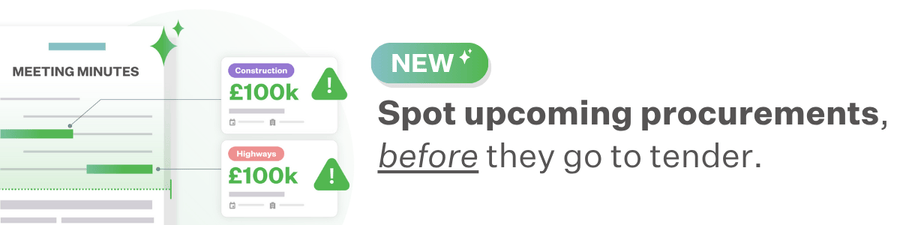
Contracting authorities regularly hint at their future procurements in published decision documents - like meeting minutes, strategy reports and procurement pipelines. Buried in these multi-hundred-page documents can be the confirmation of future investments, dates for upcoming tenders, or the authorities' strategic priorities for the year ahead.
Mine these documents for early buying signals, and you can position your team to influence and shape opportunities before they hit the official tender stage - giving your team a massive advantage against your competitors.
If your team isn't already scouring your target accounts for 2027 buying signals, you're missing a critical chance to build pipeline and momentum early.
You can gather these sources yourself manually, and/or risk expending thousands of LLM tokens scraping through them - or, get early buying signals sent straight to your inbox with Tussell.
Expanding within your existing accounts
You may not need to look far outside your existing pool of clients to hit your sales target.
There may be plenty of whitespace opportunities among your existing client cohort.
Do you know, for example, how much your key accounts spend with competitors on products & services that you could deliver?
If so, you could pitch the benefits of consolidating delivery in just one supplier: be it cost-efficiency, economies of scale, simplifying their supply chain, or (if relevant) investing more in a locally-based or small business etc.
Equally, could you expand the scope of work you're already delivering in the account? If, for example, you're successfully assisting with staff recruitment in one department, could you scale your services in adjacent departments?
You can make an even more compelling case if you're part of a compliant framework agreement, which the authority could work with you through going forward to speed up the procurement process.
Analyse your accounts' incumbent contracts using open data sources, or go a level deeper: see exactly how much your competitors are earning from key accounts using Tussell's invoice-level analysis.
Be ruthless with bid / no-bid decisions
If you've scoped out soon-to-renew contracts and early buying signals in advance, there shouldn't be too many surprise tenders landing in your inbox.
But some will always fall through the cracks, or opportunities may emerge from accounts that weren't originally on your radar.
It's never a favourable position to bid blind. Without advanced foresight of an opportunity, you'll be on the back foot and may even be working against a supplier who has worked the opportunity for months in advance.
That's why your team needs to be ruthless with which blind tenders it does and doesn't pursue. There are many factors to consider, including:
-
Does the authority have a long-standing relationship with a competitor?
-
Does the specification lend to our strengths?
-
Do we have an existing relationship with the buyer?
-
How well do we understand the buyer, their needs and strategy?
It can be difficult to say 'no' to a seemingly lucrative opportunity. But nothing will eat into your sales team and target more than wasting time bidding on work you were never positioned to win.
A targeted, concerted bidding strategy that focuses on high-probability wins will beat out a scattergun approach.
Some of this bid / no-bid intel can be gathered from open sources - but can your team afford this time doing manual research? Leading suppliers use Tussell to quickly inform them which tenders are really worth their time.
Operationalising market intel in your sales team
Taking a step back, it's also worth reflecting on how your team uses (or doesn't use) market intelligence going into 2027.
There is a wealth of publicly available data your team can use to hit your sales target - but how teams operationalise it is a very wide spectrum.
From ad hoc checks on Find a Tender, to full AI-powered tech stacks that digest and translate millions of points worth of data into recommended strategies, it's worth taking stock of where your team's data 'maturity' sits today - and where you'd want it to be in 2027.
To get a sense-check of your sales team's data maturity, hop on a call with our team, and we'll show you what they could be doing differently.
***
Ready to hit your 2027 public sector growth target?
Ambitious sales targets demand more than simply bidding for more tenders.
To grow in 2027, your team needs to be smarter about which buyers to target, where to find pipeline, which frameworks to prioritise, and which opportunities are actually worth pursuing.
The good news? Much of the intelligence needed to make these decisions is publicly available. The challenge is gathering it, making sense of it, and putting it into action before your competitors do.
That's where Tussell comes in.
Tussell brings together the market, buyer, competitor, framework and pipeline intelligence your team needs to make more informed sales decisions, without spending hours on manual research.
Whether you're looking to break into new accounts, build pipeline earlier or win more business from existing customers, we'd be happy to show you how Tussell can support your 2027 growth strategy.
Book a demo to see how Tussell can help you hit your 2027 sales target.

FAQs
1. How can I grow my public sector sales in 2027?
To grow your public sector sales in 2027, focus on identifying high-value target accounts, building a pipeline of upcoming opportunities, securing access to relevant procurement frameworks, and improving your bid win rate.
One of the most effective strategies is to identify pre-tender opportunities and early buying signals, allowing your team to engage with public sector buyers before formal procurement begins.
Public sector market intelligence platforms like Tussell help suppliers identify these opportunities, research buyers and competitors, and build a more targeted sales pipeline.
2. How much public sector pipeline do I need to hit my sales target?
To estimate how much public sector sales pipeline you need, divide your new business revenue target by your historical opportunity win rate.
For example, if your target is £2 million and your win rate is 25%, you would need approximately £8 million in qualified pipeline.
However, pipeline quality matters as much as quantity. Identifying opportunities at the pre-tender stage gives your team more time to understand buyers' requirements, develop relationships and prepare competitive bids, rather than relying solely on tenders that are already live.
3. How can I find public sector opportunities before tenders are published?
You can identify upcoming public sector contracts before tenders are published by monitoring procurement pipelines, contract expiry dates, prior information notices, preliminary market engagement notices, and public authorities' strategy documents and meeting minutes.
These sources contain early buying signals that can indicate what government organisations intend to purchase, when they might procure it, and their underlying priorities.
Tussell's Early Opportunities intelligence helps suppliers uncover these pre-tender opportunities, giving sales teams a head start to engage with buyers and build pipeline before formal competition begins.
4. How do I know which government procurement frameworks are worth joining?
To identify which public sector frameworks are worth joining, assess how frequently your target buyers use them, the value of contracts awarded through them, and which suppliers are successfully winning work.
Rather than applying for every available framework, prioritise those that provide genuine access to your target market and future sales pipeline.
Tussell's Framework and Lots Intelligence helps suppliers analyse historical framework usage, identify commercially valuable Lots and determine which agreements could support their public sector growth strategy.
5. How can I improve my chances of winning public sector tenders?
To improve your public sector tender win rate, identify opportunities early, research incumbent suppliers, understand buyers' priorities and make informed bid/no-bid decisions.
Pre-tender intelligence is particularly valuable. By identifying early buying signals months before a tender is published, suppliers have more time to engage with buyers through appropriate channels, understand their requirements and position their offering.
Tussell helps suppliers research upcoming contracts, incumbent relationships, buyer spending patterns and early-stage opportunities to inform their bidding strategies.
6. How can I generate more public sector revenue from existing customers?
To generate more public sector revenue from existing customers, identify opportunities to expand into additional departments, locations or service lines within the same organisation.
Analyse what your existing customers purchase from competing suppliers, how much they spend, and when those contracts are due for renewal.
You should also monitor early buying signals from existing accounts, such as new investment plans, published strategies and upcoming procurement activity. These can reveal expansion opportunities before they become formal tenders.
Tussell helps account managers identify this whitespace, track upcoming opportunities and prioritise accounts with the greatest potential for growth.


.png?width=800&height=450&name=NEW%20SEOAEO%20Optimised%20Blog%20Titles%20(1).png)