













.png)
![New Nav Bar - New Tag [Suppliers] PNG](https://www.tussell.com/hubfs/New%20Nav%20Bar%20-%20New%20Tag%20%5BSuppliers%5D%20PNG.png)

%20v1.png)













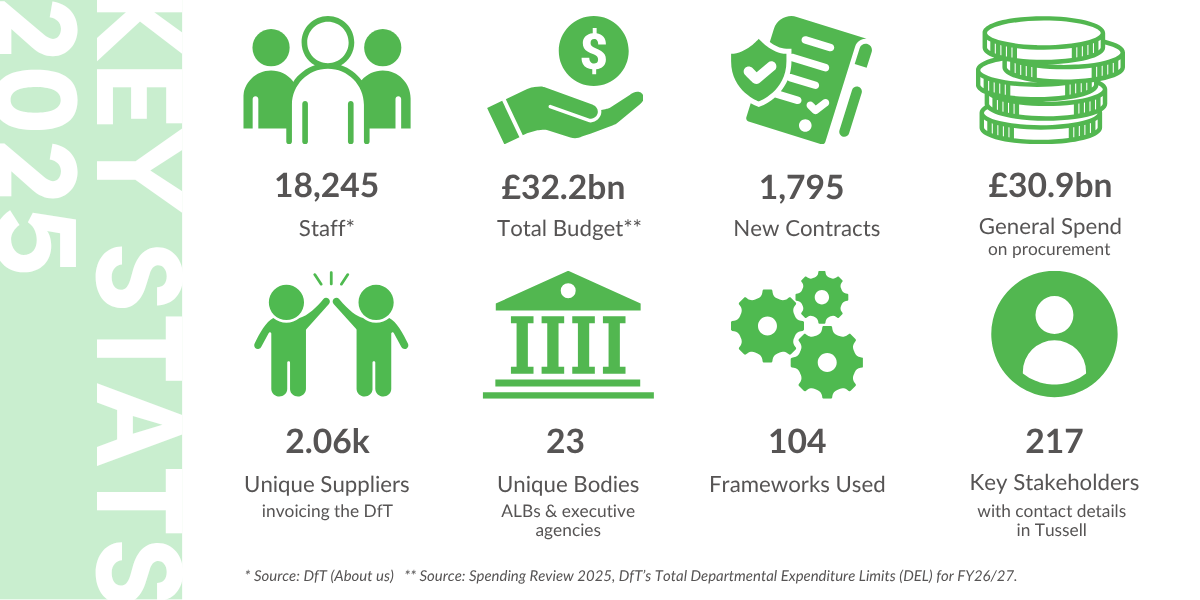
The Department for Transport (DfT) is one of the UK's largest public sector buyers, spending £30.9 billion directly with suppliers in 2025 alone.
This procurement profile explores DfT's structure and strategic priorities, before using Tussell's market-leading data to analyse its procurement spending, top suppliers, preferred frameworks and routes to market, key decision-makers, and emerging opportunities.
Skip ahead to read about:
- What is the Department for Transport (DfT)?
- What is the structure of DfT?
- Who are the DfT's Arm's Length Bodies (ALBs) and Executive Agencies?
- Who are the key stakeholders and decision-makers at DfT?
- What are DfT's strategic priorities?
- What are DfT's social value goals?
- How much does DfT spend on procurement?
- What does DfT spend money on?
- Which firms are DfT's top suppliers?
- Which routes to market (and framework agreements) does DfT use?
- Where do future DfT opportunities lie?
- What is in DfT's procurement pipeline?
- How to win more DfT contracts
What is the Department for Transport (DfT)?
DfT is the UK Central Government department responsible for supporting the UK transport network, and planning and investing in transport infrastructure.
The department - headquartered on Horseferry Road, London - consists of 23 Non-Ministerial Departments, Executive Agencies, and Non-Departmental Public Bodies.
The four largest DfT bodies (ranked by procurement spending) are the Department for Transport (DfT), High Speed Two (HS2), Network Rail, and National Highways.
These four buyers accounted for 96% of DfT's total procurement spending in 2025. (Tussell).
What is the structure of DfT?
DfT is more than a single buying organisation. The core department has a headcount of 3,440 (DfT, 2026), but its wider group includes numerous agencies and arm's-length bodies with their own budgets and procurement functions. The DVLA alone employs more than 6,100 staff.
Below the national level, devolved transport buyers (Transport for London, Transport for Greater Manchester, etc.) procure independently. Local authorities also play a key role in UK transport, conducting significant procurement across EV infrastructure, local bus services, school transport, and road maintenance.
Whilst local authorities and devolved transport buyers do form part of the wider UK transport system, they conduct procurement separately and often have their own distinct social value priorities, preferred routes to market, and procurement strategies.
Key committees and boards within DfT include the:
-
Departmental Board - overall strategy, performance and governance
-
Executive Committee - senior operational decision-making
-
Audit and Risk Assurance Committee - risk, controls and major programme assurance
-
Nominations Committee - senior leadership and succession planning
-
Investment Portfolio & Delivery Committee - major programme review
-
Strategy Committee - delivery priorities & departmental strategy
Who are the DfT's Arm's Length Bodies (ALBs) and Executive Agencies?
DfT is currently supported by 23 agencies and public bodies. These include:
Non-ministerial departments
Executive agencies
- Driver and Vehicle Standards Agency (DVSA)
- Maritime and Coastguard Agency
- Vehicle Certification Agency
Executive non-departmental public bodies
Tribunals
Public corporations
Others
- Disabled Persons Transport Advisory Committee
- Marine Accident Investigation Branch
- Rail Accident Investigation Branch
Who are the key stakeholders and decision-makers at DfT?
Political, departmental and commercial leadership is spread across DfT.
As of July 2026, its current ministerial team comprises of:
-
Heidi Alexander - Secretary of State for the Department for Transport
-
Lord Hendy of Richmond Hill - Minister of State for Rail
-
Simon Lightwood - Parliamentary Under-Secretary of State for Roads & Buses
-
Lilian Greenwood - Parliamentary Under-Secretary of State for Local Transport
-
Keir Mather- Parliamentary Under-Secretary of State for Aviation, Maritime and Decarbonisation
Beyond ministers, Tussell identifies 217 key decision-makers across DfT’s services and procurement categories. Tussell users can access their contact details, including email addresses and LinkedIn profiles.
What are DfT's strategic priorities?
DfT’s strategy can be summarised through three overarching outcomes:
-
To support economic growth by improving transport infrastructure and delivering projects on time and within budget.
-
To improve journeys for users by making transport safer, more reliable, accessible and inclusive.
-
To reduce transport’s environmental impact through decarbonisation and improved air quality.
These outcomes are currently being pursued through five more specific priorities:
-
Improve railway performance and deliver rail reform, including the transition towards Great British Railways.
-
Improve bus services and increase usage, with greater responsibility passing to local and mayoral authorities.
-
Transform infrastructure across the country, using transport investment to support growth, social mobility and regional connectivity.
-
Deliver greener transport, including electric vehicles, charging infrastructure, low-carbon fuels and active travel.
-
Better integrate the transport network, connecting different modes through improved planning, ticketing, passenger information and data.
Suppliers who can support these missions should be well placed to succeed in this account.
What are DfT's social value goals?
The Department for Transport's social value requirements are now shaped by the Central Government Social Value Model, which has a much narrower focus than its predecessor. Rather than supporting a broad range of government missions, suppliers are now expected to demonstrate how contract delivery will create good jobs, develop skills and support local communities.
The model is built around two core outcomes:
- Good jobs - creating high-quality employment, fair working conditions and fair pay.
- Skills - addressing skills shortages through training, career progression and talent pipelines.
For in-scope DfT procurements worth £1 million to £5 million, social value must account for at least 10% of the evaluation. For contracts worth £5 million or more, the minimum weighting increases to 20%.

Where possible, suppliers should take part in preliminary market engagements to help shape social value expectations before the tender stage.
How much does DfT spend on procurement?
According to Tussell's market intelligence platform, DfT procurement spending has increased significantly in recent years. Between 2019 and 2025, DfT spending with private sector suppliers increased by 77% - or 34% in real terms.
.png?width=1200&height=600&name=DfT%20Early%20Buying%20Signals%20(3).png)
Over this time period, the DfT departmental body itself has grown the fastest - with procurement spending increasing almost five-fold from £3.1bn to £15.3bn - and now accounting for 50% of total Department for Transport spending.
High Speed Two (HS2) has also undergone significant growth in public sector procurement spending - although HS2's procurement spending has decreased significantly since its 2023 peak following the cancellation of the Crewe to Manchester component.
There is a second layer of scaling-back now under consideration. In May 2026, DfT proposed changes to the technical specification intended to cut cost, complexity and delivery risk, including aligning HS2 more closely with established European railway standards rather than preserving every bespoke feature of the original design.
What does DfT spend money on?
Data from the Tussell platform shows that almost two-fifths of DfT's procurement spending is with construction & engineering firms, with a further 37.8% spent with transportation and storage providers.
This reflects DfT's continuing investment in transport and transport infrastructure.
The rest of DfT's procurement spending is split across a range of other sectors - including utilities, IT & digital, and professional services.
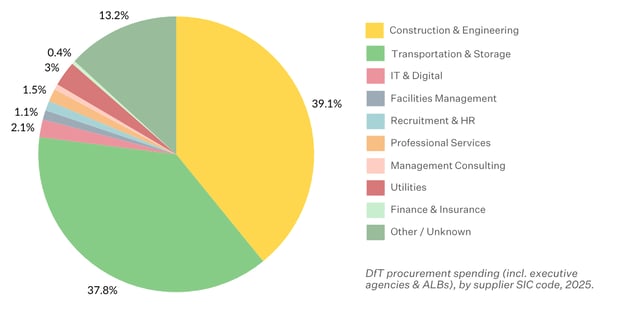
DfT's procurement split (as of 2025)
-
Construction & Engineering- 39.1%
-
Transportation & Storage - 37.8%
-
Other / Unknown - 13.2%
-
Utilities - 3.0%
-
IT & Digital - 2.1%
-
Professional Services - 1.5%
-
Recruitment & HR - 1.2%
-
Facilities Management - 1.1%
-
Management Consultiung - 0.7%
-
Finance & Insurance - 0.4%
Which firms are DfT's top suppliers?
Joint ventures (JVs) are particularly prevalent in public sector construction and engineering, and this is reflected in DfT's supplier base.
Three of the department's five largest suppliers in 2025 were joint ventures, including Balfour Beatty VINCI (the largest supplier) and EKFB (the third largest), both heavily involved in HS2 delivery.
The second largest supplier is transport operator FirstGroup.
Other major suppliers include EDF Energy, the French state-owned energy company, and passenger transport operators Abellio and Arriva, reflecting DfT's significant expenditure on rail and public transport services.
As a central government department, DfT also maintains strategic supplier relationships through the Cabinet Office's Strategic Supplier programme. Balfour Beatty and Bouygues, DfT's ninth and tenth largest suppliers respectively, are both among the Cabinet Office's 39 Strategic Suppliers.
.png?width=620&height=310&name=DfT%20Early%20Buying%20Signals%20(2).png)
DfT's top private sector suppliers by direct spending (as of 2025)
* Train operating firms are not included in this list as many are undergoing nationalisation.
-
Balfour Beatty / Vinci (JV) - £2.59bn
-
First - £2.55bn
-
EKFB (JV) - £2.26bn
-
Abellio - £1.63bn
-
Skanska / Costain / Strabag (JV) - £1.15bn
-
Arriva - £777m
-
EDF Energy - £615m
-
Connect Plus - £421m
-
Balfour Beatty - £421m
-
Bouygues - £399m
Which framework agreements does DfT use?
In 2025, DfT used 107 framework agreements across a wide range of procurement categories.
By call-off volume, its most frequently used live framework in 2025 was National Highways' Pavement Delivery Framework, National Highways' Information Technology Commercial Framework accounted for the highest value of framework call-offs.
According to Tussell's market intelligence platform, DfT and its executive agencies use frameworks for at least 53% of above-threshold procurements. Securing a place on the right frameworks (and framework Lots) - or partnering with suppliers already appointed to them - is therefore an important route to winning business with the department.
Want to see which contracts DfT awarded through these frameworks? Book in a demo of Tussell's framework analytics.
Where do future DfT opportunities lie?
Tussell's market intelligence platform identifies 805 DfT contracts due to expire - and likely to be reprocured - in 2027. Almost half of these contracts are National Highways contracts.
However, contract expiries tell only part of the story: especially for a project-heavy procurer like the DfT.
DfT is investing heavily in tranport and infrastructure. Suppliers that monitor early buying signals - not just published tenders - will be best placed to engage before they get to deep into the planning stage.
What is in DfT's procurement pipeline?
Tussell's analysis of early DfT buying signals indicates significant future demand across the construction & engineering, IT & digital, machinary & equipment, and tranportation services sectors.
Specific opportunities can be identified using Tussell's Early Opportunities Finder, which monitors thousands of pre-procurement sources - including DfT and National Highways' Commercial Procurement Pipeline, strategy papers, and meeting minutes - to surface buying signals before they reach tender stage.
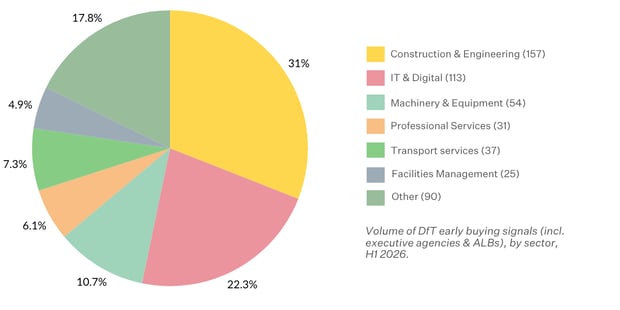
DfT's early buying signals analysed (H1 2026)
-
Construction & Engineering (157 early buying signals)
-
IT & Digital (113 early buying signals)
-
Machinary & Equipment (54 early buying signals)
-
Professional Services (31 early buying signals)
-
Transport Services (37 early buying signals)
-
Facilities Management (25 early buying signals)
-
Other (90 early buying signals)
How to win more DfT contracts
Winning business with DfT requires more than monitoring published tenders.
The department's complex structure, multiple buying organisations and mix of procurement routes mean that suppliers who engage early and in the right places have a significant advantage over those who wait for contracts to appear on Find a Tender.
In practice, the most effective approach combines several things:
-
Understand the structure. DfT procurement spans the central department, National Highways, HS2, Networkl Rail and 20 other arm's length bodies, each with their own procurement teams and budgets. Knowing which organisation is actually buying - and at what level - determines who you need to talk to.
-
Get on the right frameworks. At least 53% of above-threshold DfT procurement goes through framework call-offs. National Highways' Pavement Delivery Services is the most active - but the right ones for your firms will depend on your service offering. Suppliers without framework access either miss those opportunities entirely or need a partner that does hold a place.
-
Engage decision-makers early. DfT maintains a relationship with the Strategic Suppliers through Crown Representatives. For smaller contracts, the buying decision often sits with a commercial or category manager, not a central procurement team.
-
Monitor the pipeline before it goes to tender. The most competitive procurements are won before the ITT is published. Suppliers tracking early buying signals - strategy papers, pipeline publications, meeting minutes - can shape requirements and build relationships months ahead of the formal process.
Want to see what DfT is planning before it reaches tender? Tussell combines best-in-class market insights, framework intelligence, key decision-maker contact information, and early buying signals in one place, helping suppliers identify opportunities sooner, build stronger pipeline, and engage before requirements are fixed. Book a chat with our team today.
-1.png?width=815&height=200&name=TUSSELL_Demo_CTA_Banners%20(4)-1.png)


.png?%20NHS%20England%20Procurement%20Profile%20(13).png&width=800&height=450&name=DHSC%20%26%20NHS%20England%20Procurement%20Profile%20(13).png?%20NHS%20England%20Procurement%20Profile%20(13).png)
