












.png)
![New Nav Bar - New Tag [Suppliers] PNG](https://www.tussell.com/hubfs/New%20Nav%20Bar%20-%20New%20Tag%20%5BSuppliers%5D%20PNG.png)

%20v1.png)














On February 24th 2025, the Procurement Act officially went live.
Hailed as the biggest shake-up to UK public procurement in over a decade, the Act promised to shift government buying forever.
But now, more than a year later, what's actually changed?
This article uses Tussell data to break down three key changes in public sector buying habits - and what each means for suppliers.
Skip ahead to read about:
Not up-to-speed on the Procurement Act?
Head to our Procurement Act Hub 📚
📉 Tender volumes fell across 2025
If you look at tender volumes alone, 2025 appears to tell a simple story: fewer opportunities.
Average weekly new tender notices fell from 503 in 2024 to 393 in 2025 under the new regime.
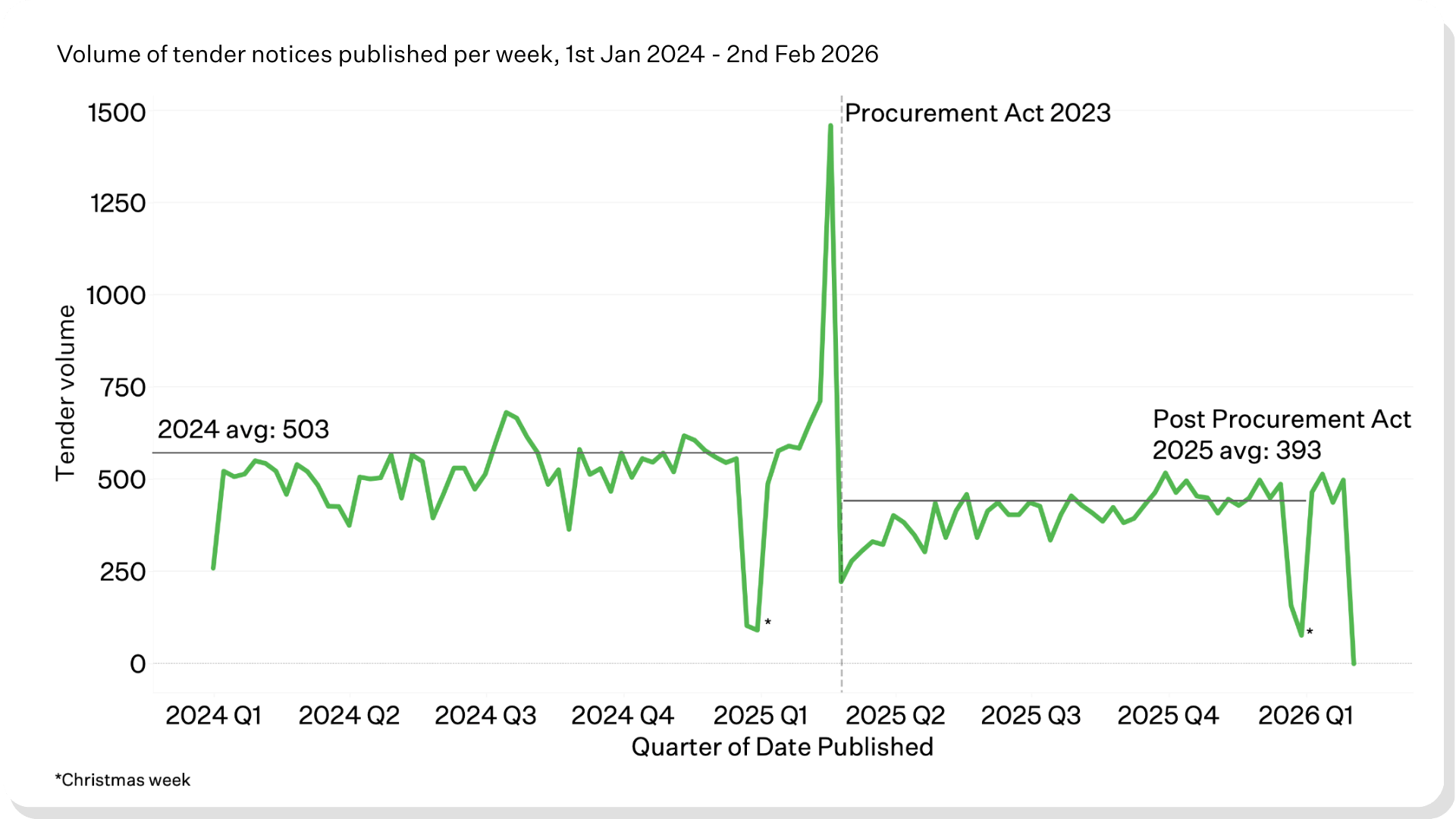
The pre–go-live tender notice spike was predictable. The sustained contraction was not.
But looking at volume alone can be misleading - the Procurement Act has not reduced public procurement per se. Rather, likely drivers include:
-
Increased contract bundling;
-
Greater use of frameworks and dynamic markets;
-
Slower publication during procedural transition.
Buyers may also be deferring to new pre-tender notices like Preliminary Market Engagement (PME) Notices or Planned Procurement Notices (PPN) before jumping into tender process pre-emptively. Tussell identified at least 8,500 PME notices being published in the first year of the Procurement Act.
For suppliers, the response is simple: if fewer tenders are being published, simply waiting for them is no longer sufficient.
Tracking pre-tender signals - Preliminary Market Engagement Notices, Pipeline Notices, Planned Procurement Notices and other early indicators - is increasingly critical to identifying opportunities sooner and building pipeline.
And, with a growing proportion of contracts now awarded via framework agreements, anticipating which frameworks unlock opportunities is now key to public sector success.
💡 One in five above-threshold tenders now use the Competitive Flexible Procedure
The introduction of the Competitive Flexible Procedure (CFP) represents a material shift in how large contracts are being procured.
-1.png?width=1920&height=1080&name=5%20trends%20for%202025%20(2)-1.png)
Our analysis shows that in the first year of the Procurement Act, one in five new above-threshold tender notices were tagged as using the CFP -impressive uptake for a brand new procedure type.
Usage of the CFP varies by category and government vertical. Transport buyers are the most likely to use the new procedure, while Local Government remains hesitant.
Buyers using this procedure have greater discretion than ever before to design multi-stage procurement processes - adding negotiation, dialogue, site visits, or other assessment stages.
For suppliers, this increases variability in bidding. Timelines are less predictable, processes may be longer, and costs can rise.
Bid/no-bid discipline matters more. Identifying procedure type early is necessary but not sufficient.
By analysing invoice-level spend and wider procurement data, bid teams can assess incumbency strength, competitive intensity and buyer behaviour before committing resources - reducing exposure to protracted, low-probability bids.
🌱 Contracts are being set aside for VCSEs, SMEs and local firms
The Procurement Act initially created uncertainty over whether contracting authorities could reserve contracts for certain types of suppliers.
Tussell data showed that many local authorities were reserving contracts for local and smaller suppliers, despite the legislation not technically permitting them to do so.
That ambiguity has since been addressed through The Local Government (Exclusion of Non-commercial Considerations) (England) Order 2026, granting Local Government the power to reserve below-threshold contracts for UK or locally-based suppliers.
Since go-live last year, we've identified at least 536 notices reserving work for SMEs & VCSEs, and 310 notices reserving work by region. In the grand scheme of public procurement, this is quite small - but it does represent a meaningful new lever.
Reservation gives procurement teams a compliant mechanism to advance social value objectives, local economic development and third-sector participation.
With new Central Government SME direct spend targets reset last year - and VCSE targets expected soon - this tool may become more prominent as departments look for practical delivery routes.

However, suppliers should retain perspective. Local Government remains the strongest-performing vertical for SME and VCSE spend by a wide margin. For smaller firms building a direct go-to-market strategy, councils continue to offer structurally better access than most central departments.
How are SMEs faring in the market today? Get the latest snapshot with the British Chamber of Commerce, AutogenAI & Tussell's SME Procurement Tracker.
🎯 What this means for suppliers
The Procurement Act has not transformed the market overnight. Nor has it meaningfully expanded opportunity volume. However, complexity has increased.
Fewer published tenders, more discretion in procedure design, and the gradual embedding of reservation powers all point in the same direction: surface-level notice tracking is no longer enough.
Suppliers relying on reactive bidding models face three structural risks:
-
Reduced visibility as frameworks concentrate opportunities
-
Higher bid costs as Competitive Flexible Procedure introduces longer, less standardised processes
-
Selective access where contracts are reserved or strategically shaped to meet policy objectives
The firms best positioned under the new regime are not necessarily those bidding more. They are those:
-
Mapping frameworks before tenders emerge
-
Interpreting pre-tender notices and early buying signals to influence future specifications
-
Analysing incumbency and buyer behaviour before committing bid resources
-
Building strategic partnerships aligned to where access is structurally constrained
These capabilities require systematic data, not manual monitoring.
Tussell combines notice data, framework intelligence, and invoice-level spend analysis to give suppliers visibility before opportunities reach the market - and clarity on where they are genuinely competitive.
If your team is still relying on reactive tender alerts, the risk profile has changed.
Book a call with the Tussell team to see how leading public sector sales teams are adapting.