












.png)
![New Nav Bar - New Tag [Suppliers] PNG](https://www.tussell.com/hubfs/New%20Nav%20Bar%20-%20New%20Tag%20%5BSuppliers%5D%20PNG.png)

%20v1.png)














Today, on June 22. 2026, Sir Keir Starmer announced his resignation as leader of the Labour Party and Prime Minister of the United Kingdom.
It's the same day that Andy Burnham, who is likely to replace the PM, is set to be sworn in as MP for Makerfield after winning a by-election last week.
Burnham, who until recently served for nine years as Mayor of Greater Manchester, is often praised for having ushered in significant growth and development in the area.
So, with his potential leadership bid imminent, we wanted to understand the role public procurement played during his time as Mayor, using Tussell's procurement and spend data to unpack how the Greater Manchester Combined Authority's (GMCA’s) relationship with private sector suppliers changed over the last several years of his tenure.
GMCA’s direct procurement data not only provides a useful lens for journalists seeking to understand how Burnham’s agenda shaped the supplier market in Greater Manchester, but also for suppliers looking to win work with the authority.
Skip ahead to read about:
- How much does GMCA spend with management consultants?
- Conclusion: what Burnham’s GMCA record could tell us about his wider approach to public procurement
💸 How much does GMCA spend with private sector suppliers?
In 2025, GMCA spent £366m procuring goods and services from private sector suppliers.
This represented a 25% increase on pre-COVID levels, but a 3% fall in real terms, according to the Bank of England’s inflation calculator.
-2.png?width=680&height=578&name=DHSC%20procurement%20spending%20(3)-2.png)
Source: Tussell
Over the same period, total Local Government procurement spending across the UK increased by more than 60% - or 25% in real terms.
At first glance, this suggests GMCA’s private sector procurement spend has fallen behind the wider Local Government market. But this comparison misses a major feature of Burnham’s tenure: the growing role of intra-public-sector transfers. Once invoices between public authorities have been included, GMCA’s apparent underspend disappears.

The clearest example of this phenomenon is in transport.
Burnham’s flagship Bee Network, which was launched in 2023, saw GMCA channel increased funding through Transport for Greater Manchester (TfGM), which then procured from private operators and suppliers. In other words, private sector opportunities have moved downstream.
Burnham's Bee Network brought Greater Manchester’s buses under a single, locally controlled brand through three franchising tranches, alongside wider investment in smart ticketing and passenger information systems.
💡 The Key Takeaway: Selling into Greater Manchester increasingly means targeting multiple buyers. That means building relationships with key stakeholders, tracking frameworks, and monitoring early buying signals across GCMA, FtGM, TMFRS, and more.
🌱 How much does GMCA spend with SMEs and local firms?
GMCA records significant procurement spending with local firms compared to other local authorities. This is not too surprising, given the strength of Manchester’s economy relative to other parts of the country.
However, GMCA’s record on SME procurement is weaker.
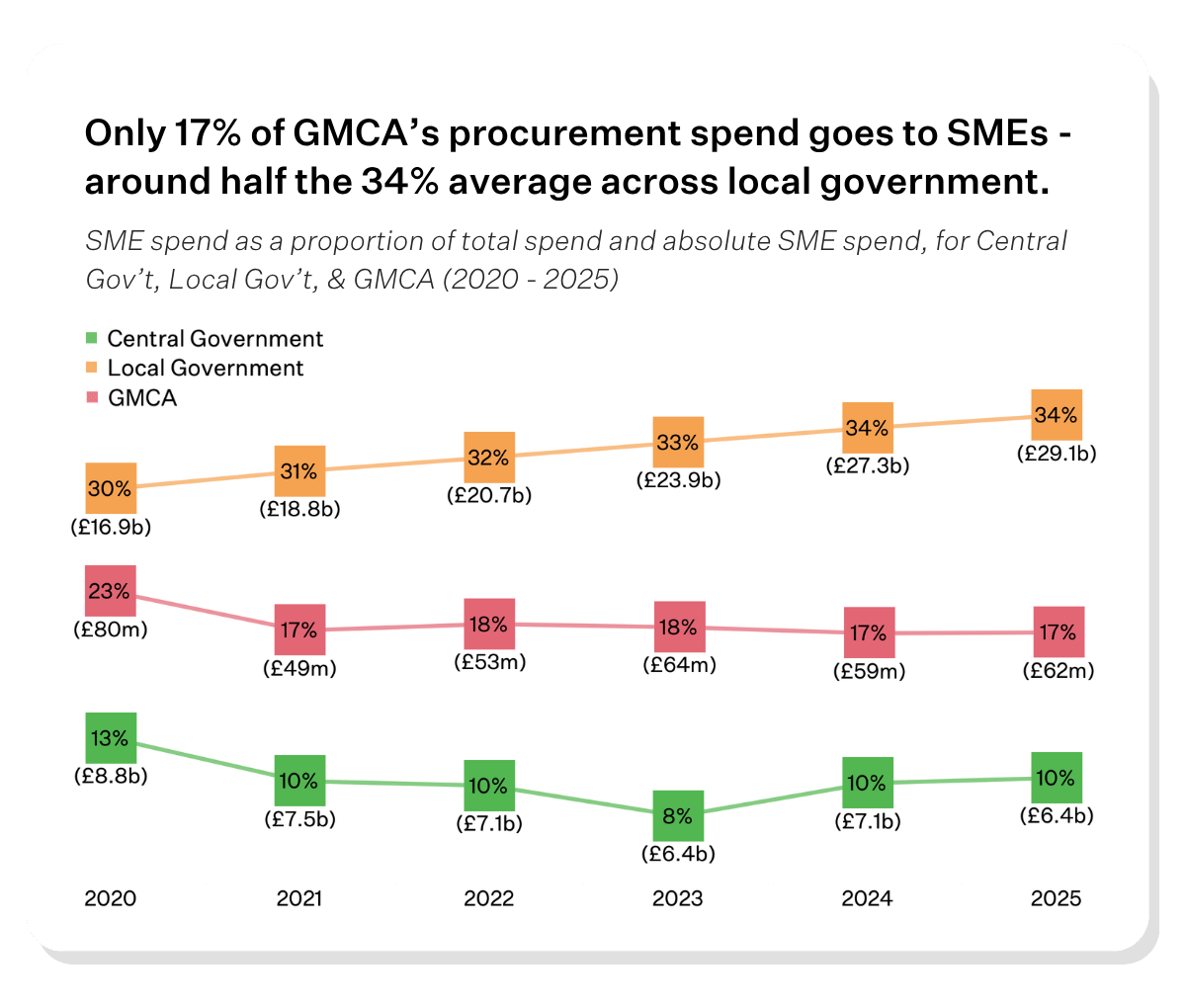
Amid renewed focus on public spending with SMEs and new departmental direct SME spending targets, SMEs account for just 17% of GMCA’s procurement spend - around half the Local Government average.
 Source: Tussell
Even more strikingly, GMCA’s procurement spending with SMEs fell in both relative and absolute terms between 2020 and 2025, while SME spend across Local Government as a whole increased.
GMCA’s strategic role across 10 metropolitan boroughs makes SME procurement more challenging than for smaller local authorities. Larger, cross-boundary programmes often require a level of scale and capacity that can favour bigger suppliers.
💡 The Key Takeaway: Local Government still offers SMEs a more accessible route into the public sector than Central Government. But Manchester’s declining SME spend may be an early warning sign: as local government reorganises and consolidates, could smaller suppliers find themselves squeezed out?
📊 How much does GMCA spend with management consultants?
During his time as Prime Minister, Sir Keir Starmer pledged to reduce public sector spending on management consultancy after sustained media scrutiny of rising costs.
Tussell’s 2026 Public Sector Management Consulting Market Report puts this debate in context, revealing that management consultancy accounts for just 2% of total public procurement spending.
But Burnham’s record at GMCA could still matter politically. As the leading candidate to replace Keir Starmer, GMCA’s consultancy spend would provide a case study of whether Burnham's public control agenda translated into lower reliance on external advisers.
-3.png?width=1200&height=1020&name=DHSC%20procurement%20spending%20(2)-3.png) Source: Tussell
Source: Tussell
Analysis using Tussell’s market intelligence platform shows that GMCA’s spending with management consultancy firms climbed significantly between 2019 and 2025, with outlay increasing threefold from pre-COVID levels.
This finding requires additional context. Around 70% of GMCA’s recent procurement spend with consultancy firms has gone to The Growth Company, a delivery partner closely linked to GMCA, rather than a conventional external consultancy.
As of May 2026, an open FOI request is asking GMCA to clarify whether it treats The Growth Company as an in-house delivery vehicle, Teckal-exempt provider, arm’s-length contractor or strategic partner.
💡 Did you know: GMCA isn't alone - Local Government spending with management consultants has increased by 105% between FY19/20 - FY24/25 - significantly outpacing growth in both Central Government and the NHS.
With English Devolution likely to add new complexities to local governance, this trend could accelerate in the short to medium term. For consultants, Local Government is an increasingly important growth market.
🌅 Conclusion: what Burnham’s GMCA record could tell us about his wider approach to public procurement
Burnham’s procurement record at GMCA is more complex than a simple story of higher or lower private sector spend.
GMCA’s direct supplier payments show private sector procurement has fallen slightly in real terms, SME spend has weakened, and spending with consultants has risen sharply over the past few years.
And, crucially, some of Burnham’s major priorities are delivered through GMCA-linked bodies, meaning suppliers monitoring GMCA alone will increasingly miss key opportunities in the region - particularly across the transport sector.
To see how Tussell helps suppliers understand the top frameworks, early buying signals and competitive landscape across GMCA, TMFRS, TfGM, and other contracting authorities, book a chat with the Tussell team.



.png?width=800&height=450&name=Use%20data%20to%20find%20the%20right%20partners%20(12).png)