












.png)
![New Nav Bar - New Tag [Suppliers] PNG](https://www.tussell.com/hubfs/New%20Nav%20Bar%20-%20New%20Tag%20%5BSuppliers%5D%20PNG.png)

%20v1.png)











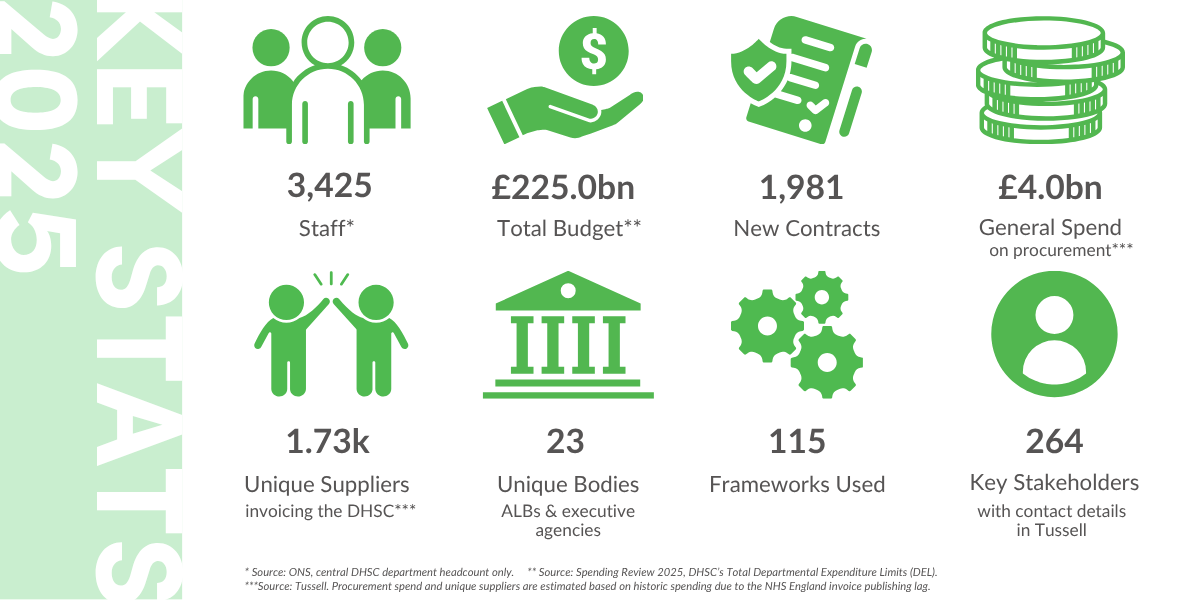
The Department of Health and Social Care (DHSC) is one of the UK's largest public sector buyers, spending £4 billion directly with suppliers in 2025 alone.
This procurement profile explores DHSC's structure and strategic priorities, before using Tussell's market-leading data to analyse its procurement spending, top suppliers, preferred frameworks and routes to market, key decision-makers, and emerging opportunities.
Skip ahead to read about:
- What is the Department of Health & Social Care (DHSC)?
- What is the structure of DHSC?
- Who are the DHSC's Arm's Length Bodies (ALBs) and Executive Agencies?
- Who are the key stakeholders and decision-makers at DHSC?
- What are DHSC's strategic priorities?
- What are DHSC's social value goals?
- How much does DHSC spend on procurement?
- What does DHSC spend money on?
- Which firms are DHSC's top suppliers?
- Which routes to market (and framework agreements) does DHSC use?
- Where do future DHSC opportunities lie?
- What is in DHSC's procurement pipeline?
- How to win more DHSC contracts
What is the Department of Health & Social Care (DHSC)?
DHSC is the UK Central Government department responsible for health and social care, and ensuring that people live longer, healthier and more independent lives.
The department - headquartered on Victoria Street, London - consists of 23 Non-Ministerial Departments, Executive Agencies, and Non-Departmental Public Bodies.
The three largest DHSC bodies (ranked by procurement spending) are NHS England, the Department of Health & Social Care and UK HSA.
These three buyers accounted for 82% of DHSC's total procurement spending in 2024 (the last full year for which invoice-level NHS England spending data is available). (Tussell).
What is the structure of DHSC?
DHSC is more than a single buying organisation. The core department has a headcount of 3,425 (ONS, 2026), but its wider group includes numerous agencies and arm's-length bodies with their own budgets and procurement functions. The UK Health Security Agency alone employs more than 5,800 staff.
.png?width=620&height=310&name=%C2%A34.0bn%20(1).png)
NHS England is sometimes treated separately, with its own leadership and procurement activity.
However, new legislation proposes abolishing the organisation and transferring its functions into a restructured DHSC and other parts of the health system, potentially reshaping where responsibilities, budgets and procurement decisions sit. For that reason, in this procurement profile, NHS England and the 22 agencies are included in our DHSC analysis.
Below the national level, integrated care boards, NHS trusts and foundation trusts also procure independently. While they form part of the wider health system, these conduct procurement independently and often have their own distinct social value priorities, preferred routes to market, and procurement strategies.
Key committees and boards within DHSC include the:
-
Departmental Board - overall strategy, performance and governance
-
Executive Committee - senior operational decision-making
-
Audit and Risk Assurance Committee - risk, controls and major programme assurance
-
Nominations and Governance Committee - senior leadership and succession planning
Who are the DHSC's Arm's Length Bodies (ALBs) and Executive Agencies?
DHSC is currently supported by 23 agencies and public bodies. These include:
Executive agencies
Executive non-departmental public bodies
Special health authorities
Advisory non-departmental public bodies
- British Pharmacopoeia Commission
- Commission on Human Medicines
- Committee on Mutagenicity of Chemicals in Food, Consumer Products and the Environment
- Independent Reconfiguration Panel
- NHS Pay Review Body
- Review Body on Doctors’ and Dentists’ Remuneration
Other sponsored bodies
Who are the key stakeholders and decision-makers at DHSC?
Political, departmental and commercial leadership is spread across DHSC.
Its current ministerial team comprises:
-
James Murray - Secretary of State for Health and Social Care
-
Karin Smyth - Minister of State for Health (Secondary Care)
-
Stephen Kinnock - Minister of State for Care
-
Baroness Merron - Parliamentary Under-Secretary of State for Women’s Health and Mental Health
-
Sharon Hodgson - Parliamentary Under-Secretary of State for Public Health and Prevention
-
Preet Kaur Gill - Parliamentary Under-Secretary of State for Health Innovation and Safety
Beyond ministers, Tussell identifies 264 key decision-makers across DHSC’s services and procurement categories. Tussell users can access their contact details, including email addresses and LinkedIn profiles.
What are DHSC's strategic priorities?
DHSC’s priorities are now largely framed by the 10 Year Health Plan for England, built around three long-term shifts: moving care from hospitals into communities, from analogue to digital, and from treating sickness to preventing it.
Its immediate priorities include reducing waiting times, improving NHS productivity, modernising technology and data infrastructure, strengthening the health and social care workforce, and upgrading the estate.
The proposed abolition of NHS England will also reshape where national responsibilities, budgets and procurement decisions sit.
What are DHSC's social value goals?
DHSC's social value requirements are now shaped by the Central Government Social Value Model, which has a much narrower focus than its predecessor. Rather than supporting a broad range of government missions, suppliers are now expected to demonstrate how contract delivery will create good jobs, develop skills and support local communities.
The model is built around two core outcomes:
- Good jobs - creating high-quality employment, fair working conditions and fair pay.
- Skills - addressing skills shortages through training, career progression and talent pipelines.
For in-scope DHSC procurements worth £1 million to £5 million, social value must account for at least 10% of the evaluation. For contracts worth £5 million or more, the minimum weighting increases to 20%.

Where possible, suppliers should take part in preliminary market engagements to help shape social value expectations before the tender stage.
How much does DHSC spend on procurement?
According to Tussell's market intelligence platform, DHSC procurement spending has fallen sharply from its COVID-19 peak of £24.4bn in 2021.
Tussell estimates 2025 procurement spending at around £4.0bn, although this remains provisional because NHS England has not yet published a full set of transparency invoices. (Learn more about the Central Government invoice publishing gap).
What does DHSC spend money on?
Data from the Tussell platform shows that almost a quarter of DHSC's procurement spending is with IT and digital firms, reflecting the department's continued investment in digital transformation, data infrastructure and technology-enabled healthcare.
A further 20.6% of spending is directed towards health and social work providers.
The rest of DHSC's procurement spending is split across a range of other sectors - primarily professional services, management consulting, and facilities management.
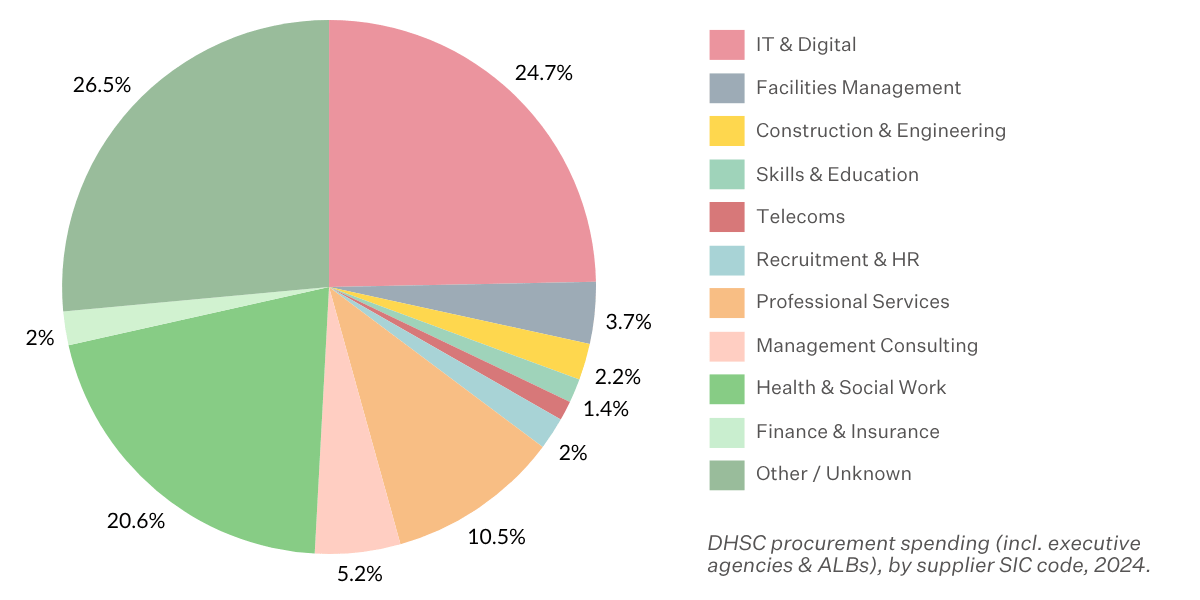
DHSC's procurement split (as of 2024)
-
Other / Unknown - 26.5%
-
IT & Digital - 24.7%
-
Health & Social Work - 20.6%
-
Professional Services - 10.5%
-
Management Consulting - 5.2%
-
Facilities Management - 3.7%
-
Construction & Engineering - 2.2%
-
Finance & Insurance - 2%
-
Recruitment & HR - 2%
-
Skills & Education - 1.4%
-
Telecoms - 1%
Which firms are DHSC's top suppliers?
G4S, BBVA and Moderna are DHSC's largest private sector suppliers by public sector revenue. Other major suppliers include technology firms such as Bytes, CGI and Accenture, alongside healthcare companies including Pfizer and Alliance Medical.
DHSC and NHS England also maintain a list of 15 NHS Strategic Suppliers, including Johnson & Johnson, Sodexo and ISS. While many do not appear among DHSC’s largest direct suppliers by spend, each is overseen by a Health Crown Representative because of its critical role in delivering goods, services and innovation across the wider health system.
.png?width=620&height=310&name=%C2%A34.0bn%20(4).png)
DHSC's top suppliers by direct spending (as of 2024)
-
G4S - £319 million
-
BBVA - £281 million
-
Moderna - £258 million
-
Narayana Health - £256 million
-
Bytes - £233 million
-
CGI - £131 million
-
Alliance Medical - £120 million
-
CBRE - £106 million
-
Pfizer - £104 million
-
Accenture - £102 million
Which framework agreements does DHSC use?
In 2025, DHSC used 115 framework agreements across a wide range of procurement categories.
By call-off volume, its most frequently used live framework in 2025 was G-Cloud 14, while RM6098 Technology Products and Associated Services 2 (TePAS 2) accounted for the highest value of framework call-offs.
According to Tussell's market intelligence platform, DHSC and its executive agencies use frameworks for at least 32% of above-threshold procurements. Securing a place on the right frameworks (and framework Lots) - or partnering with suppliers already appointed to them - is therefore an important route to winning business with the department.
| Top DHSC frameworks, ranked | Volume of call-offs (2025) |
|
G-Cloud 14 |
124 |
|
National Microbiology Framework |
77 |
|
TePAS 2 |
67 |
Want to see which contracts DHSC awarded through these frameworks? Book in a demo of Tussell's framework analytics.
Where do future DHSC opportunities lie?
Tussell's market intelligence platform identifies 796 DHSC contracts due to expire - and likely to be reprocured - in 2027. More than a third (263) are technology contracts.
However, contract expiries tell only part of the story.
DHSC is investing heavily in AI, digital healthcare, cyber security, workforce transformation and the modernisation of NHS infrastructure, creating opportunities beyond reprocurements. Suppliers that monitor early buying signals - not just published tenders - will be best placed to engage before procurements formally begin.
What is in DHSC's procurement pipeline?
Tussell's analysis of early DHSC buying signals indicates significant future demand across the IT & Digital, Skills & Education, Health & Social Work, and Professional Services sectors.
Specific opportunities can be identified using Tussell's Early Opportunities Finder, which monitors thousands of pre-procurement sources - including DHSC's Commercial Procurement Pipeline, strategy papers, and meeting minutes - to surface buying signals before they reach tender stage.
.png?width=1200&height=600&name=%C2%A34.0bn%20(3).png)
DHSC's early buying signals analysed (H1 2026)
-
IT & Digital (89 early buying signals)
-
Health & Social Work (76 early buying signals)
-
Other (51 early buying signals)
-
Skills & Education (28 early buying signals)
-
Professional Services (28 early buying signals)
How to win more DHSC contracts
Winning business with DHSC requires more than monitoring published tenders. The department's complex structure, multiple buying organisations and mix of procurement routes mean that suppliers who engage early and in the right places have a significant advantage over those who wait for contracts to appear on Find a Tender.
In practice, the most effective approach combines several things:
-
Understand the structure. DHSC procurement spans the central department, NHS England and 22 other arm's length bodies, each with their own procurement teams and budgets. Knowing which organisation is actually buying - and at what level - determines who you need to talk to.
-
Get on the right frameworks. At least 32% of above-threshold DHSC procurement goes through framework call-offs. G-Cloud 14 and TePAS 2 are the most active. Suppliers without framework access either miss those opportunities entirely or need a partner that does hold a place.
-
Engage decision-makers early. DHSC and NHS England maintain relationships with strategic suppliers through Crown Representatives. For smaller contracts, the buying decision often sits with a commercial or category manager, not a central procurement team.
-
Monitor the pipeline before it goes to tender. The most competitive procurements are won before the ITT is published. Suppliers tracking early buying signals - strategy papers, pipeline publications, meeting minutes - can shape requirements and build relationships months ahead of the formal process.
Want to see what DHSC is planning before it reaches tender? Tussell combines best-in-class market insights, framework intelligence, key decision-maker contact information, and early buying signals in one place, helping suppliers identify opportunities sooner, build stronger pipeline, and engage before requirements are fixed. Book a chat with our team today.
-1.png?width=815&height=200&name=TUSSELL_Demo_CTA_Banners%20(4)-1.png)