

![[Gov] Nav Bar Icons - Solutions - Procurement](https://www.tussell.com/hubfs/New%20Nav%20Bar%20Icons%202024/%5BGov%5D%20Nav%20Bar%20Icons%20-%20Solutions%20-%20Procurement.png)
![[Gov] Nav Bar Icons - Solutions - Snr Leadership](https://www.tussell.com/hubfs/New%20Nav%20Bar%20Icons%202024/%5BGov%5D%20Nav%20Bar%20Icons%20-%20Solutions%20-%20Snr%20Leadership.png)
![[Gov] Nav Bar Icons - Solutions - Policy & Research](https://www.tussell.com/hubfs/New%20Nav%20Bar%20Icons%202024/%5BGov%5D%20Nav%20Bar%20Icons%20-%20Solutions%20-%20Policy%20%26%20Research.png)
%20v1.png)

![[Gov] Nav Bar Icons - Product - Framework Intelligence](https://www.tussell.com/hubfs/New%20Nav%20Bar%20Icons%202024/%5BGov%5D%20Nav%20Bar%20Icons%20-%20Product%20-%20Framework%20Intelligence.png)
![[Gov] Nav Bar Icons - Product - Supplier Groups](https://www.tussell.com/hubfs/New%20Nav%20Bar%20Icons%202024/%5BGov%5D%20Nav%20Bar%20Icons%20-%20Product%20-%20Supplier%20Groups.png)
![Tussell Website - Nav Bar - Analyst Service [Gov] (1)](https://www.tussell.com/hubfs/Tussell%20Website%20-%20Nav%20Bar%20-%20Analyst%20Service%20%5BGov%5D%20(1).png)
![New Nav Bar - New Tag [Gov]](https://www.tussell.com/hubfs/New%20Nav%20Bar%20-%20New%20Tag%20%5BGov%5D.png)
![[Gov] Nav Bar Icons - Product - Integrations](https://www.tussell.com/hubfs/New%20Nav%20Bar%20Icons%202024/%5BGov%5D%20Nav%20Bar%20Icons%20-%20Product%20-%20Integrations.png)
![[Gov] New Nav CTA - Product, Frameworks Finder (rounded) v1](https://www.tussell.com/hubfs/%5BGov%5D%20New%20Nav%20CTA%20-%20Product%2c%20Frameworks%20Finder%20(rounded)%20v1.png)
![[Gov] Nav Bar Icons - Insights - Reports](https://www.tussell.com/hubfs/New%20Nav%20Bar%20Icons%202024/%5BGov%5D%20Nav%20Bar%20Icons%20-%20Insights%20-%20Reports.png)
![[Gov] Nav Bar Icons - Insights - Blog](https://www.tussell.com/hubfs/New%20Nav%20Bar%20Icons%202024/%5BGov%5D%20Nav%20Bar%20Icons%20-%20Insights%20-%20Blog.png)
![Tussell Website - Nav Bar - Events [Gov]](https://www.tussell.com/hubfs/Tussell%20Website%20-%20Nav%20Bar%20-%20Events%20%5BGov%5D.png)
![[Gov] Nav Bar Icons - Insights - Procurement Act](https://www.tussell.com/hubfs/New%20Nav%20Bar%20Icons%202024/%5BGov%5D%20Nav%20Bar%20Icons%20-%20Insights%20-%20Procurement%20Act.png)
![[Gov] Nav Bar Icons - Insights - Newsletter](https://www.tussell.com/hubfs/New%20Nav%20Bar%20Icons%202024/%5BGov%5D%20Nav%20Bar%20Icons%20-%20Insights%20-%20Newsletter.png)
![[Gov] Nav Bar Icons - Insights - Press](https://www.tussell.com/hubfs/New%20Nav%20Bar%20Icons%202024/%5BGov%5D%20Nav%20Bar%20Icons%20-%20Insights%20-%20Press.png)

![[Gov] Nav Bar Icons - Product - KDM](https://www.tussell.com/hubfs/New%20Nav%20Bar%20Icons%202024/%5BGov%5D%20Nav%20Bar%20Icons%20-%20Product%20-%20KDM.png)

.png?width=1280&height=800&name=BCC%20SME%20Procurement%20Tracker%20(2026).png)
.png?width=80&height=80&name=james%20v2%20(1).png)



Direct government procurement spend with SMEs has hit a six-year high.
That's the key finding from the British Chambers of Commerce & Tussell's 2026 SME Procurement Tracker - the market's annual benchmark for assessing the government's SME spending performance.
Download the full 2026 SME Procurement Tracker here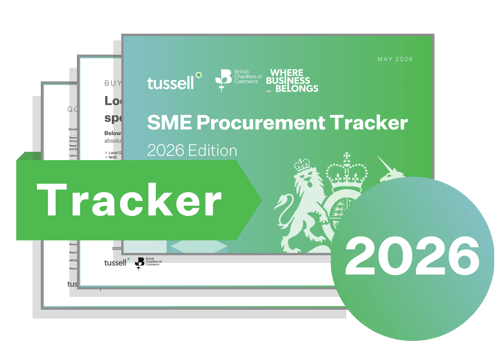
The Tracker - now in its fourth year - paints a positive national trajectory, with SMEs earning more directly from government than ever before.
But dig a bit deeper, and areas for improvement become clear. Local Government has managed to consistently improve its spending with small businesses, but Central Government departments have stagnated for several years.
This is particularly relevant following freshly set departmental SME spending targets, with the Tracker suggesting most departments have a long way to go to achieve them. Without concerted effort to do so, past performance suggests these department's will continue to plateau.
Dig into all of key findings in the full Tracker - click here to download.
Got a question about the Tracker? Get in touch with Tussell at contact@tussell.com
Media citations
-
June 2026: The Rest is Money podcast, 'Why we need fewer civil servants'. The SME Tracker was cited by former COO to UK Government Stephen Kelly on an episode of The Rest is Money, ft. Robert Peston & Steph McGovern.
FAQs
What is the SME Procurement Tracker?
The Tracker is annual report published jointly by Tussell and the British Chambers of Commerce. It draws on data from Tussell's public sector market intelligence platform to objectively benchmark the state of direct procurement with SMEs across England.
The Tracker has been referred to across government, in Parliament and civil society to understand how successfully the UK public sector is supporting small businesses through procurement.
Who are Tussell?
Founded in 2015, Tussell is the market's trusted source of insight on UK public procurement. Our market intelligence platform gives you a complete view of the UK public procurement landscape - from early buying signals and live tenders, to contracts, framework agreements, and spending data - all in one place.
Major government suppliers and contracting authorities rely on Tussell's insights to make data-led commercial decisions in the public sector market. Our insights are also relied upon by the national media when reporting on government contracting, with our data being cited over 1,500 times in the press since 2018.
Who are the British Chambers of Commerce?
The British Chambers of Commerce (BCC) sits at the heart of a powerful network of 51 Chambers of Commerce across the UK, representing tens of thousands of firms. It provides a unified voice for these companies, rooted in their communities, at the national level. We link our UK network with over 75 international member chambers, to promote trade and investment, and work for a better future for businesses around the world.
How much does the UK public sector spend with SMEs?
The BCC & Tussell's 2026 SME Procurement Tracker found that the UK public sector spent £45.2 billion with SMEs in 2025. This represented 21% of all direct procurement, a six-year high. This is up two percentage points on the year prior, bucking the stagnant trend of the last few years.
Which areas of the UK public sector spend most with SMEs?
Local Government spends the most directly with SMEs, both by value and proportion of total spend (£29.1bn and 34% in 2025, respectively)
Local authorities have successfully managed to increase both measures year-on-year since 2020.
NHS bodies, by comparison, spent £7.3bn directly with SMEs in 2025, representing 16% of their total procurement footprint. This proportion has remained broadly flat since 2020.
Central Government spends the least by volume and proportion directly with SMEs, at £6.4bn and 10% respectively in 2025. Both these measures are down on their 2020 performance - a concerning trajectory if government is to meet its newly imposed Direct SME Spending Targets.
Which public sector markets do SMEs win the most contracts in?
SMEs tend to perform better in categories which award smaller value, more locally-focused contracts.
33% of all spending with Education, Training & Recruitment suppliers went to SMEs in 2025. By contrast, this proportion was just 3% in the Defence sector.
If the public sector wants to spend more directly with SMEs, disaggregating larger contracts into more deliverable smaller deals will make them more viable for SMEs.